

OpenAI has introduced a dedicated ChatGPT for Teens featuring Study Mode, homework safeguards, and parental controls designed to promote learning over cheating. Developed with expert guidance, the version includes age-appropriate content protections and partnerships to enhance critical thinking regarding AI.
The launch represents a significant change from the way ChatGPT was initially offered to younger users. When ChatGPT arrived in late 2022, it did not include protections specifically designed around the needs and vulnerabilities of teenagers. OpenAI is now putting those safeguards directly into a dedicated teen experience.
The timing is notable, particularly as generative AI has become increasingly common in classrooms and among students. For teenagers, the question is no longer simply whether AI can answer a homework question. It is whether an AI assistant can help students learn without becoming a shortcut around the learning process.
How can I help you learn?
Explore how a teen-focused AI assistant could encourage learning instead of simply providing homework answers.
Instead of immediately giving you the completed answer, let’s start with the first step.
What information do you already have?
ChatGPT for Teens Puts Study Mode at the Center
Same question. Different AI experience.
Compare an answer-first interaction with a guided-learning approach.
What information do you already have?
One of the most important parts of the new ChatGPT for Teens experience is Study Mode.
Rather than immediately producing an answer, Study Mode is designed to guide students through their coursework. The system can use questions, explanations and step-by-step assistance to help teenagers work through material themselves.
That approach changes the role of ChatGPT from an answer generator into something closer to a digital study partner.
OpenAI has also added quizzes and learning visualizations to support the educational experience. These features are intended to make interaction with course material more active rather than simply giving students a completed response.
The distinction matters because generative AI can make it extremely easy to bypass difficult parts of an assignment. A student facing a complicated problem can ask a chatbot for the answer in seconds. Study Mode is intended to push that interaction in the opposite direction: helping the student understand how to reach the answer.
Homework Safeguards Are Designed to Discourage Cheating
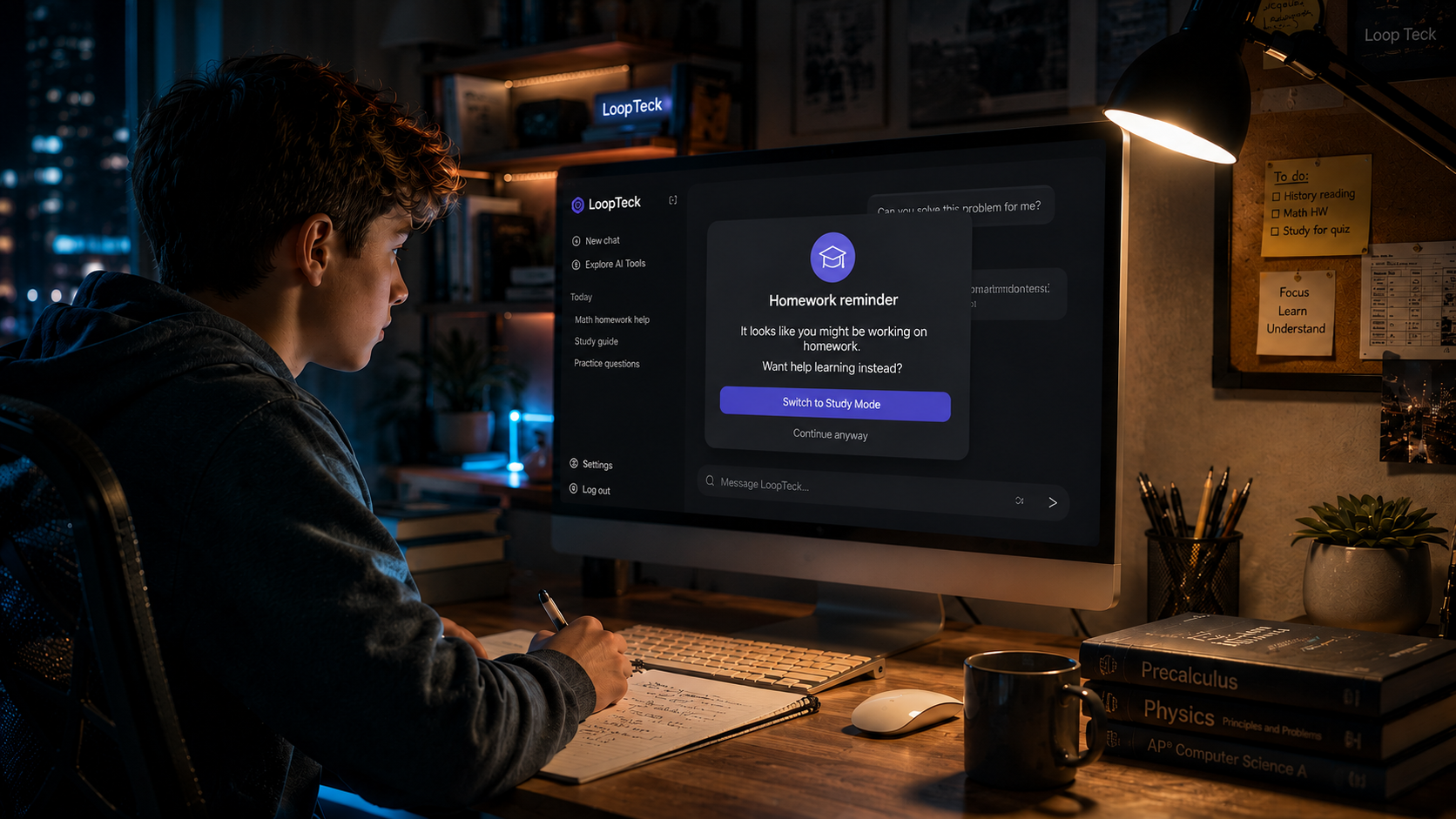
OpenAI is also introducing a specific safeguard for homework-related use.
When the system detects that a teenager may be trying to use ChatGPT to complete an assignment rather than learn from it, a homework reminder can appear. The reminder encourages the student to switch to Study Mode.
It does not mean that ChatGPT is being removed from the homework process. Instead, OpenAI is attempting to change how the tool participates in it.
That is an important distinction. AI-assisted education is unlikely to disappear simply because schools discourage students from using chatbots. The more practical challenge is finding ways for students to use these systems without allowing them to replace the reasoning and practice that assignments are meant to develop.
ChatGPT for Teens Gives Parents More Control
Parental controls are another major component of the new experience.
Parents or guardians can control certain aspects of how the teen version operates, including whether Study Mode is enabled by default. They can also establish Quiet Hours, giving families a way to limit when the service can be used.
Safety & learning controls
Explore how parental controls could be presented in a teen-focused AI experience.
Enable guided learning by default.
Limit access during selected hours.
Receive important safety notifications.
Content protections are active by default.
OpenAI is also providing safety notifications for parents.
The controls are designed to give guardians more visibility and influence over how teenagers interact with the chatbot without making parents responsible for monitoring every conversation manually.
This is particularly relevant because a general-purpose AI assistant can be used for a huge range of activities. Homework is only one use case. Teenagers may also turn to AI for advice, explanations, entertainment or personal conversations.
That broader range of interactions makes age-appropriate safeguards more important than simply blocking individual categories of questions.
Age-Appropriate Protections Will Be Enabled by Default

OpenAI says age-appropriate content protections will be active by default for teenagers.
The company says those protections were developed using developmental science and guidance from subject-matter experts. The goal is to reduce exposure to material that could be harmful or inappropriate for a younger audience.
The move reflects a broader challenge facing AI companies: a system capable of discussing almost any subject needs different boundaries depending on who is using it.
A safeguard designed for an adult user may not be appropriate for a teenager. OpenAI’s dedicated approach attempts to account for that difference at the product level rather than treating all users identically.
The company has also announced a partnership with CodeAI aimed at helping young users understand how artificial intelligence works and how to evaluate AI-generated information critically.
That educational component is important because safety is not only about restricting content. Teenagers also need to understand that AI systems can produce incorrect information, reflect limitations in their training and require critical evaluation.
Why OpenAI Is Focusing More Heavily on Teen Safety
The launch comes amid legal scrutiny surrounding ChatGPT’s potential effects on young users.
OpenAI is facing multiple lawsuits concerning the mental health impact of ChatGPT on teenagers, including cases connected to teen suicides. Those legal disputes add significant context to the company’s decision to introduce more explicit protections for younger users.
The new safeguards therefore arrive at a complicated moment for OpenAI.
ChatGPT has grown from a newly released chatbot into a service used by hundreds of millions of people every week. Yet its rapid adoption also exposed questions about how a general-purpose AI system should handle vulnerable users, particularly teenagers.
The dedicated teen experience is an attempt to address some of those concerns through product design.
It does not eliminate every risk associated with AI use. Instead, it gives OpenAI a framework specifically built around younger users, including educational safeguards, parental controls and age-appropriate content protections.
ChatGPT for Teens Could Change How Students Use AI
The bigger question is whether teenagers actually use these tools as intended.
A Study Mode that encourages learning is useful only if students engage with it rather than searching for ways around it. Similarly, parental controls can give families additional tools, but they cannot replace communication and responsible technology use at home.
The launch nevertheless signals a shift in how AI companies are approaching education.
Instead of treating students simply as another category of chatbot users, OpenAI is designing features around the specific relationship between teenagers, schoolwork and AI. That includes recognizing when an interaction may involve homework, encouraging guided learning and giving parents controls over parts of the experience.
For educators and parents, the important issue will be whether these features actually improve how students learn.
For OpenAI, the challenge is broader. The company now has to demonstrate that a powerful general-purpose AI assistant can be made useful for teenagers without simply becoming a faster way to avoid difficult work or exposing younger users to material they are not prepared to handle.
ChatGPT for Teens is an important step in that direction, but its real test will happen after teenagers start using it at scale. The effectiveness of Study Mode, homework reminders and parental controls will ultimately depend on how well they work in the messy reality of everyday student life.
ChatGPT for Teens: Your Questions Answered
Explore the key questions surrounding OpenAI’s dedicated ChatGPT experience for teenagers, including Study Mode, homework safeguards, parental controls, safety protections and AI literacy.
What would you like to know about ChatGPT for Teens?
Select a question below. Each answer will appear as a separate conversation.
? What is ChatGPT for Teens? ›
✦ What is Study Mode and how does it work? ›
✓ How does ChatGPT for Teens discourage homework cheating? ›
◉ What parental controls are available? ›
◷ What are Quiet Hours? ›
! What safety protections are enabled for teenagers? ›
</> What is the CodeAI partnership about? ›
◇ Why is AI literacy important for teenagers? ›
i Why is OpenAI introducing a teen-specific ChatGPT experience? ›


Loop Teck
✓Technology, AI, smartphones & the future of innovation.