


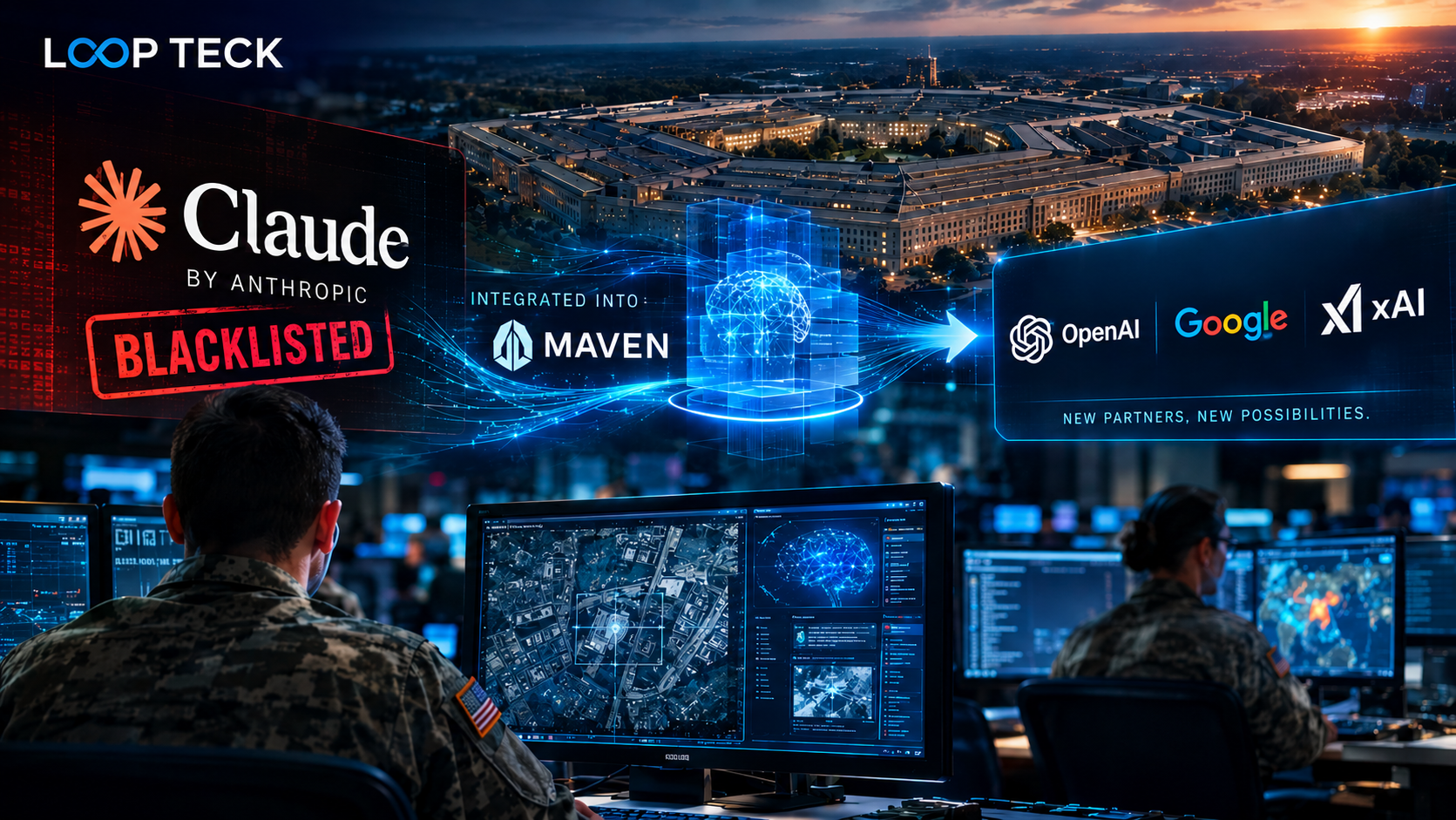
The U.S. Department of Defense says it has ceased using Anthropic’s products, ending a months-long dispute that began when Defense Secretary Pete Hegseth designated Anthropic a national security supply-chain risk. The Pentagon had originally set a deadline to phase out the company’s technology, but the supplied reporting indicates that Claude continued to be used inside defense workflows well after that decision.
That delay is significant. Multiple people familiar with the Pentagon’s AI operations told the BBC that Anthropic’s Claude was still being used as recently as the previous week for research, analysis and intelligence work, including through Palantir’s Maven Smart System.
The dispute therefore raises a larger question than why Anthropic was blacklisted: how difficult is it for a major institution to remove an AI model once that model is deeply integrated into its infrastructure?
The Pentagon says Anthropic is now out
The Pentagon confirmed Monday that it has stopped using Anthropic products.
That statement closes a chapter that began in February, when Defense Secretary Pete Hegseth designated Anthropic a national security supply-chain risk and ordered the company’s technology to be phased out.
The original decision followed a dispute over how Anthropic’s Claude models could be used by the military.
The Pentagon wanted Anthropic to remove restrictions from its AI systems and provide the military with broader access. Anthropic refused, citing concerns surrounding mass surveillance and autonomous weapons.
The company subsequently called the Pentagon’s designation “unprecedented and unlawful” and sued the Trump administration.
What makes the latest development unusual is the timing.
The Pentagon had announced a six-month phase-out period, yet sources familiar with its AI operations said Claude remained active during the dispute.
Claude reportedly remained embedded in defense workflows
The supplied reporting says Claude was still being used for research, analysis and intelligence gathering as recently as last week.
Sources also said the model was being used in military operations against Iran.
Claude’s role reportedly extended beyond individual employees simply opening an AI chatbot. The model was embedded within a larger Pentagon data platform operated by Palantir.
That platform is the Maven Smart System, which the reporting describes as the Pentagon’s primary platform for organizing intelligence and other data.
This distinction explains why the Pentagon’s transition took longer than the original announcement might have suggested.
Why removing Claude was not as simple as deleting an AI tool
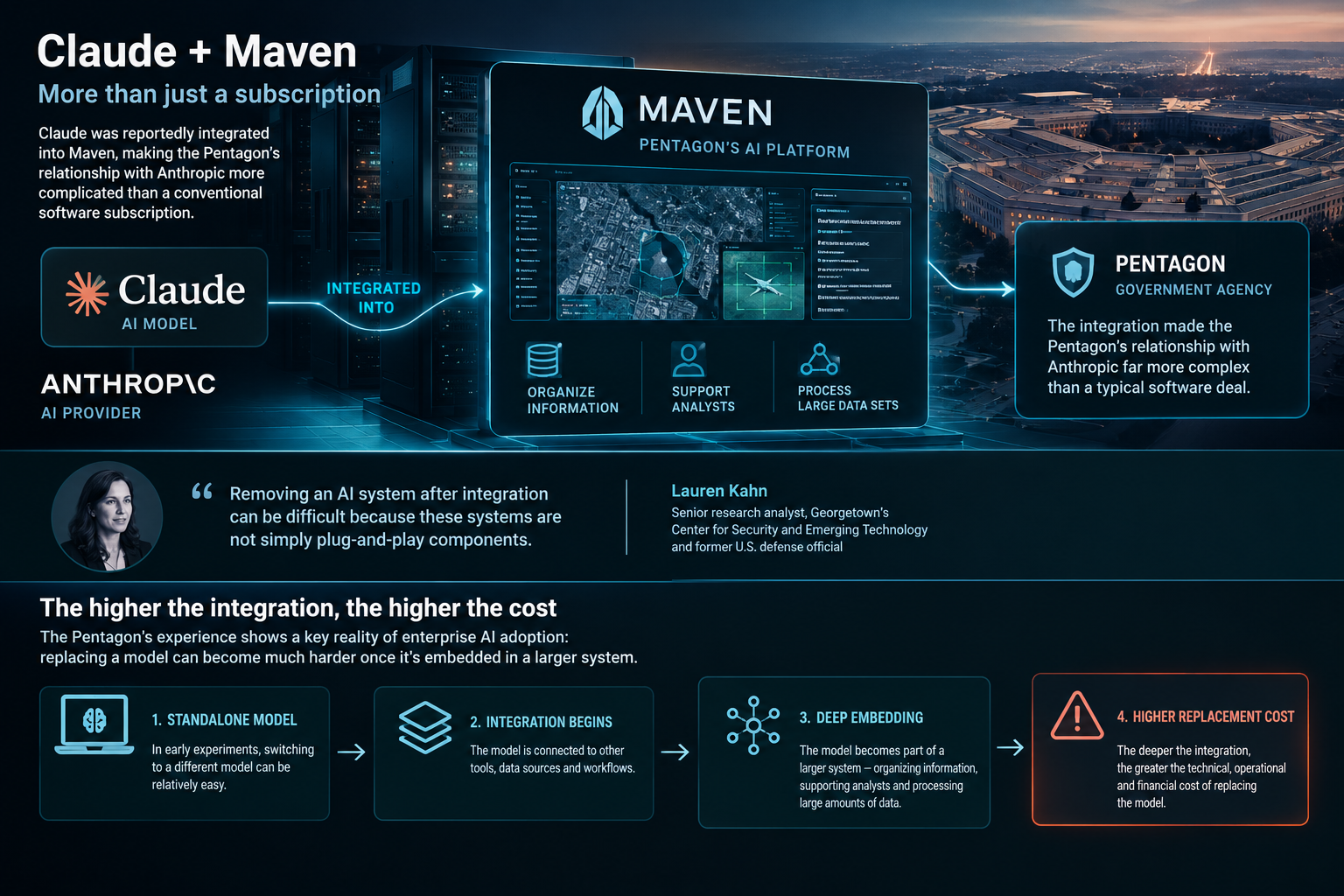
Claude was reportedly integrated into Maven, making the Pentagon’s relationship with Anthropic more complicated than a conventional software subscription.
Lauren Kahn, a senior research analyst at Georgetown’s Center for Security and Emerging Technology and a former U.S. defense official, said removing an AI system after integration can be difficult because these systems are not simply plug-and-play components.
That has broader implications for government AI adoption.
An organization can choose a different model relatively easily when experimenting with standalone software. The calculation changes when an AI model becomes part of a larger system used to organize information, support analysts and process large amounts of data.
The Pentagon’s Anthropic AI transition therefore illustrates a less visible part of enterprise AI adoption: the cost of replacing a model can grow after the model becomes operationally embedded.
What was Claude reportedly doing inside Maven?
The reported use cases centered on handling and analyzing large volumes of information.
Sources familiar with the technology said analysts and defense officials could use Maven to organize visual information such as satellite imagery and drone footage. That information could then be processed by Claude and other large language models for analytical tasks, including identifying potential military targets.
The reporting also says officials used the technology while preparing one-page briefs for senior decision-makers.
That makes the Pentagon’s decision more consequential than a simple vendor change.
If an AI model is contributing to an established intelligence workflow, replacing it potentially involves more than substituting one model for another. The surrounding software, processes and users may also need to adapt.
Anthropic’s dispute was about more than commercial access
At the center of the conflict was Anthropic’s position on military use.
The Pentagon pushed the company to remove safety guardrails and provide broader access to Claude. Anthropic rejected that demand because of concerns involving mass surveillance and autonomous weapons.
The disagreement exposed a fundamental tension in the defense-AI market.
Government agencies want increasingly capable models that can operate across sensitive and demanding environments. AI companies, meanwhile, still have to decide which applications their systems will permit.
Those positions can overlap for a while.
But once the government requires capabilities that a company considers unacceptable, a commercial relationship can become a policy dispute.
Anthropic’s subsequent lawsuit against the Trump administration turned that disagreement into a broader legal fight.
OpenAI, Google and xAI are now part of the picture
The Pentagon’s Anthropic exit is occurring as the department works with other major AI companies.
The supplied reporting says the Pentagon has signed contracts with Google, xAI and OpenAI.
OpenAI’s technology has reportedly gained wider adoption in some defense departments in recent months, according to people familiar with AI use within the department.
That does not necessarily mean one company has simply replaced Anthropic everywhere.
The Pentagon’s systems are complex, and different models can serve different functions. The reported transition also demonstrates why the government may not treat AI vendors as interchangeable components.
For defense organizations, model capabilities, security requirements, contractual terms and acceptable-use policies can all influence which systems are deployed.
The timing makes the dispute even more notable
Hegseth’s order to phase out Anthropic came on February 27, one day before the U.S. and Israel attacked Iran, according to the supplied reporting.
Yet sources said Pentagon personnel continued using Anthropic’s Claude models throughout the controversy.
That reported overlap provides important context for the eventual cutoff.
It suggests that the Pentagon’s dependency on Anthropic technology did not disappear simply because a policy decision had been made.
The episode also shows how quickly AI moved from an experimental technology into infrastructure that government organizations may depend upon for day-to-day work.
Anthropic and the White House are still talking
The Pentagon dispute has not completely defined Anthropic’s relationship with the Trump administration.
The supplied report says President Donald Trump met Anthropic CEO Dario Amodei twice at the White House during the previous week.
After one meeting involving Trump and other technology leaders, Amodei said he remained concerned about AI risks but suggested that working with the president could allow those risks to be addressed safely.
Trump subsequently praised Amodei.
That creates an unusual contrast.
The Pentagon has now confirmed that it has stopped using Anthropic products, while the company’s leadership has continued direct discussions with the White House.
The legal and political dispute is therefore not necessarily the end of Anthropic’s relationship with the U.S. government.
What the Pentagon’s Anthropic exit actually tells us
The most important lesson is not simply that one AI company lost a government relationship.
It is that AI procurement decisions become much harder once models are embedded into operational infrastructure.
The reported use of Claude inside Maven demonstrates the difference between testing an AI model and building a workflow around it.
The Pentagon ultimately stopped using Anthropic’s products. But the fact that the transition took months, despite a previously announced phase-out, suggests that replacing a deeply integrated model can require significant technical and organizational work.
It also gives the Pentagon’s growing relationships with OpenAI, Google and xAI another dimension.
The question is no longer only which AI model is the most capable.
For institutions deploying AI at scale, another question matters just as much:
What happens when the institution and the AI company no longer agree on how that model should be used?
Practical Takeaway
The Pentagon has confirmed that it has ceased using Anthropic products, but the supplied reporting shows that the transition was not immediate.
Claude reportedly remained part of Pentagon workflows after Anthropic was designated a supply-chain risk, including through Palantir’s Maven platform. The episode highlights the growing importance of AI infrastructure decisions inside government and other large organizations.
For AI companies, the dispute demonstrates the commercial consequences of safety policies.
For government agencies, it highlights another risk: dependency on AI systems can make vendor changes considerably more complicated after deployment.
The next development to watch is not simply whether Anthropic returns to Pentagon systems. The more consequential question is how the U.S. government defines acceptable AI safeguards when increasingly capable models become part of sensitive operational infrastructure.
Pentagon × Anthropic What Happened?
Explore the key questions behind the Pentagon’s decision to stop using Anthropic’s AI tools.
The Pentagon stopped using Anthropic products after a dispute over military access to Claude and the company’s AI safety restrictions. Defense Secretary Pete Hegseth had designated Anthropic a national security supply-chain risk after the company refused demands for broader, unrestricted military access.
According to people familiar with Pentagon AI operations, Claude was still being used as recently as the week before the Pentagon confirmed that it had stopped using Anthropic products. The reported uses included research, analysis and intelligence gathering.
Sources cited in the report said Claude was used for tasks including research, analysis and intelligence work. It was also reportedly integrated into the Pentagon’s Maven Smart System, where AI models could help process large quantities of information and visual intelligence data.
Claude was reportedly embedded into the larger Maven platform. That meant removing it was more complicated than simply cancelling an AI subscription. Lauren Kahn of Georgetown’s Center for Security and Emerging Technology said deeply integrated AI systems are not simply plug-and-play components.
Maven Smart System is a Pentagon data platform operated by Palantir. The supplied reporting describes it as a major system for organizing intelligence and other data, including visual information such as satellite imagery and drone footage.
The report says the Pentagon has signed contracts with other major technology companies, including OpenAI, Google and xAI. OpenAI tools have also reportedly gained wider adoption in some military departments.
Anthropic refused the Pentagon’s request for broader access to its AI products because of concerns surrounding mass surveillance and autonomous weapons. That disagreement eventually became a major legal and political dispute between the company and the administration.
The dispute highlights a larger challenge in enterprise AI: replacing a model can become difficult once it is deeply integrated into operational systems. It also shows the tension that can emerge when government agencies want broader AI capabilities while model providers maintain safety limits on certain uses.
Answers are based on the reporting and information covered in this article. Reported claims are identified as such and should not be treated as independently confirmed facts.

Loop Teck
✓Technology, AI, smartphones & the future of innovation.