

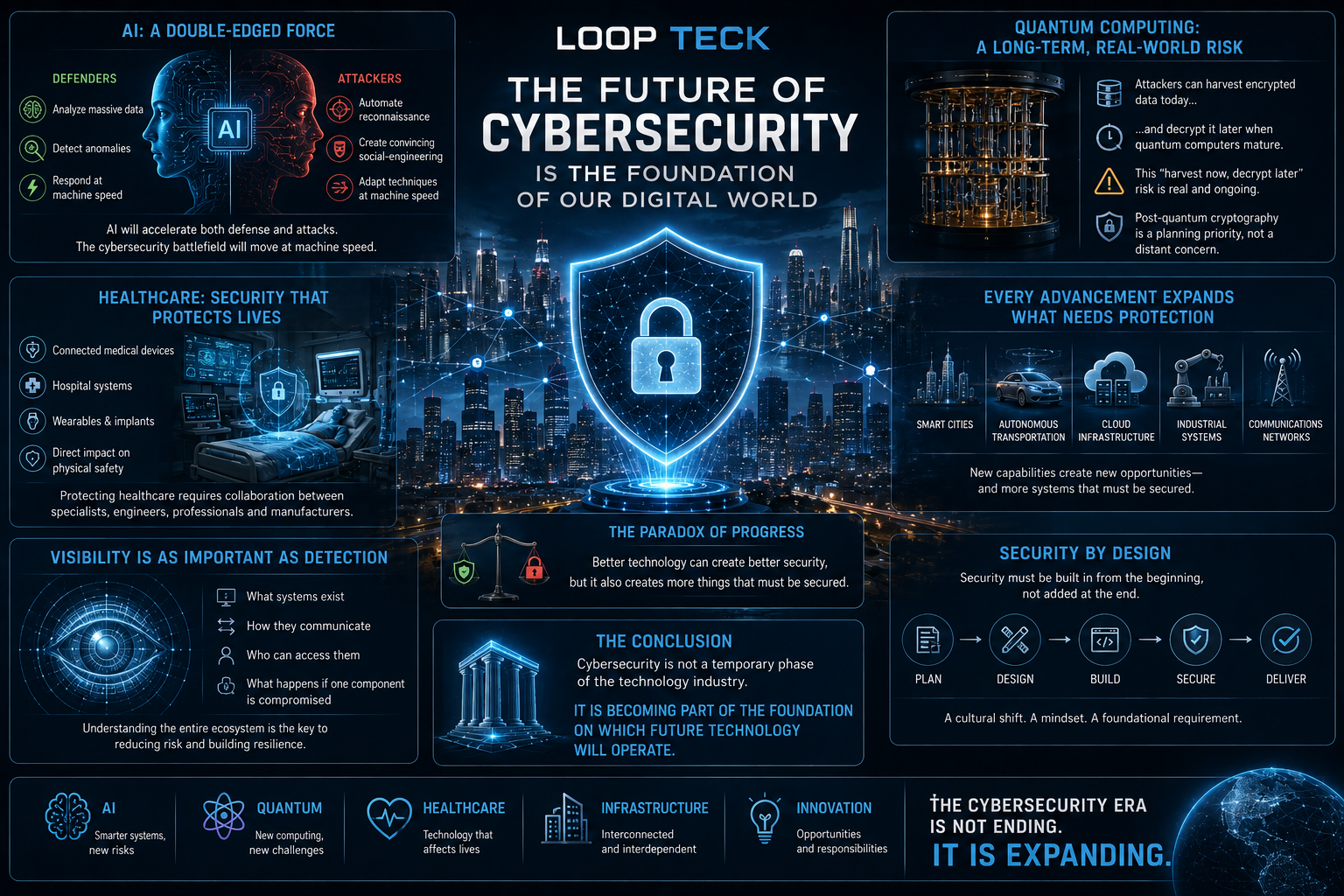
Cybersecurity is no longer simply an IT problem, and the cybersecurity industry is unlikely to become less important as technology advances. If anything, the opposite is happening. As artificial intelligence, autonomous machines, connected infrastructure and quantum computing reshape the digital world, protecting those systems is becoming a prerequisite for using them safely.
That changes the question.
Instead of asking when cybersecurity will finally be “solved,” it may be more useful to ask how much more important it becomes as civilization becomes increasingly dependent on software.
The answer could be significant.
What started with antivirus programs, passwords and network firewalls has expanded into a much broader discipline protecting cloud platforms, financial networks, industrial systems, healthcare technology and critical infrastructure. By 2050, security could become so deeply embedded into digital systems that users barely notice it.
The cybersecurity era is not ending.
It is getting larger.
Why Cybersecurity Will Keep Expanding
The simplest reason cybersecurity will remain essential is also the hardest one to escape: the digital attack surface keeps growing.
Every connected device creates another potential entry point. Every cloud service introduces another dependency. Every automated process creates another system that could potentially be manipulated.
The expansion is already visible.
Smart buildings, connected vehicles, industrial control systems, remote healthcare platforms and Internet of Things devices are moving computing into places where software once played a limited role. As these systems become interconnected, the consequences of a successful attack can extend far beyond a compromised laptop or stolen password.
A breach involving an online account might expose personal information.
A breach involving industrial equipment could interrupt physical operations.
That distinction matters.
The future of cybersecurity will increasingly involve protecting systems that people depend on without necessarily realizing how much software sits underneath them.
How the Cybersecurity Industry Is Changing With AI
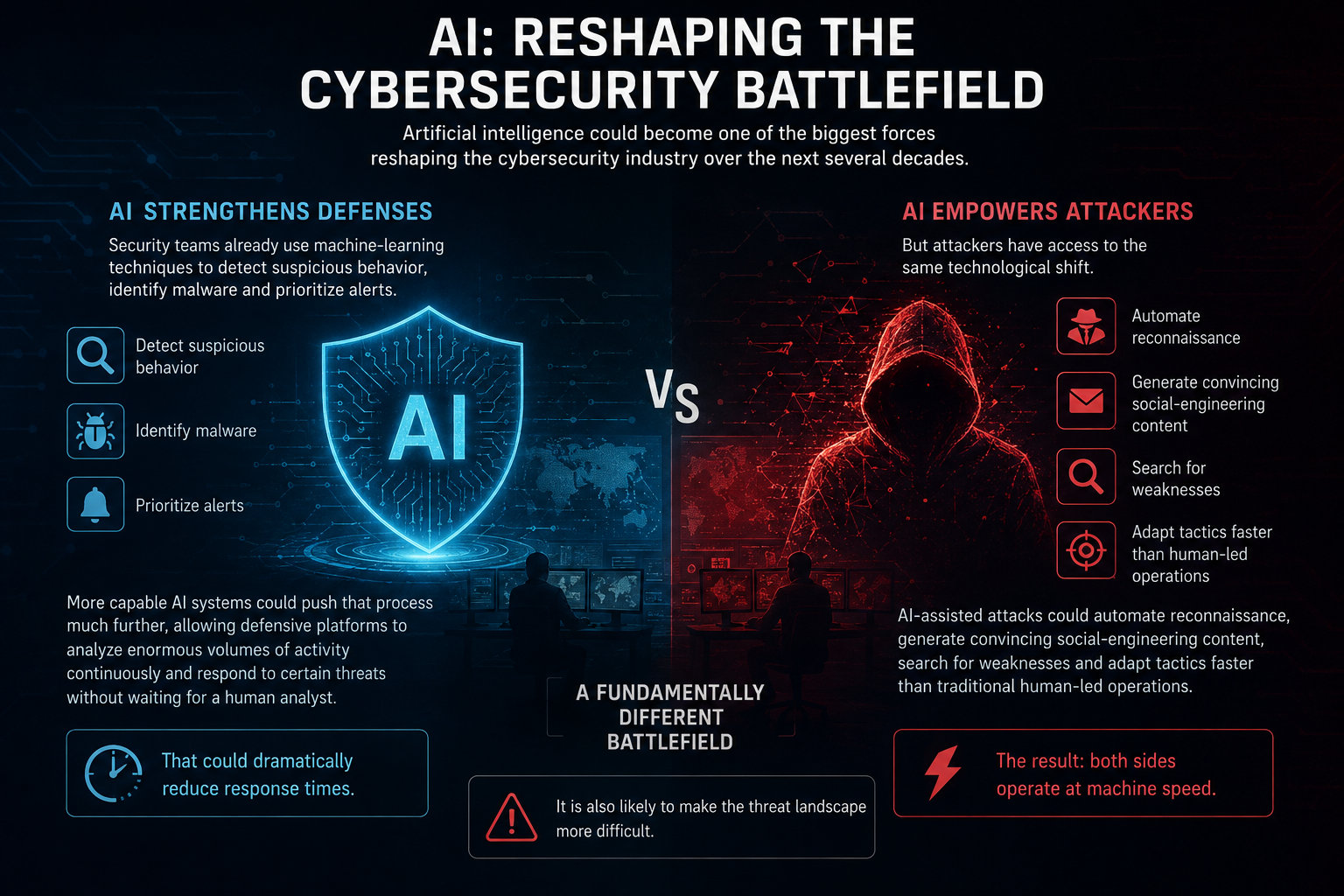
Artificial intelligence could become one of the biggest forces reshaping the cybersecurity industry over the next several decades.
It is also likely to make the threat landscape more difficult.
Security teams already use machine-learning techniques to detect suspicious behavior, identify malware and prioritize alerts. More capable AI systems could push that process much further, allowing defensive platforms to analyze enormous volumes of activity continuously and respond to certain threats without waiting for a human analyst.
That could dramatically reduce response times.
But attackers have access to the same technological shift.
AI-assisted attacks could automate reconnaissance, generate convincing social-engineering content, search for weaknesses and adapt tactics faster than traditional human-led operations. The result could be a security environment where both sides operate at machine speed.
That is a fundamentally different battlefield.
AI Could Make Cybersecurity More Autonomous
The security operations center of the future may look very different from the one organizations operate today.
Instead of analysts manually examining endless streams of alerts, autonomous systems could investigate suspicious behavior, correlate events across multiple environments and isolate compromised devices automatically.
Human professionals would still matter. Their role could simply move upward.
They may spend more time designing security policies, investigating unusual incidents, evaluating automated decisions and managing strategic risk rather than responding manually to every individual alert.
There is a catch.
An autonomous defense system must also know when not to act.
A false positive that locks down a harmless computer is inconvenient. A false positive that shuts down a critical industrial process could be extremely disruptive.
For that reason, the next generation of cybersecurity will need not only faster AI, but more reliable AI governance and human oversight.
Cybersecurity Faces a Quantum Computing Problem
Artificial intelligence is only one technological shift that could redefine digital security.
Quantum computing presents another.
Modern encryption protects everything from online banking and private communications to corporate systems and government networks. Some widely used public-key cryptographic algorithms rely on mathematical problems that are extremely difficult for classical computers to solve efficiently.
A sufficiently capable, fault-tolerant quantum computer could change that.
This is why cybersecurity researchers and standards organizations are working on post-quantum cryptography, designed to resist attacks from future quantum machines.
The challenge is not simply inventing new algorithms.
Organizations must eventually deploy them across enormous technology environments containing legacy software, hardware, databases, applications and communication systems. Some of that infrastructure can remain operational for decades.
That makes cryptographic migration a long-term engineering project.
Post-Quantum Cybersecurity Will Require Years of Preparation
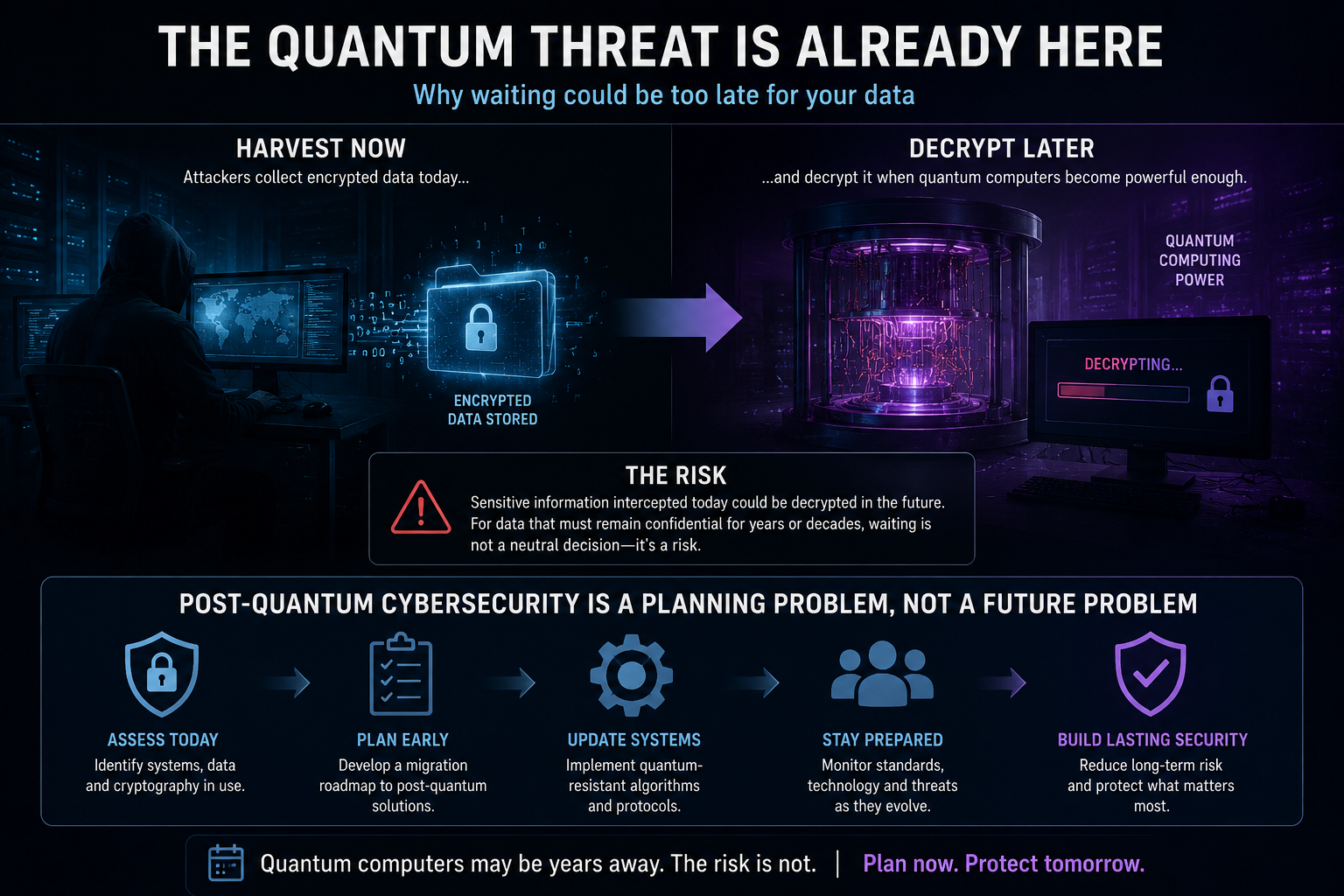
The quantum threat also creates a problem that exists before large-scale quantum computers arrive.
Attackers can potentially collect encrypted information today and attempt to decrypt it later if sufficiently capable quantum systems become available. This scenario is commonly described as “harvest now, decrypt later.”
For information that needs to remain confidential for many years, waiting for quantum computers to become practical could therefore be too late.
The transition toward post-quantum cybersecurity is consequently not something organizations can treat as a distant science-fiction problem.
It is a planning problem.
Cybersecurity Is Moving Into Healthcare and Biology
The boundaries of cybersecurity are also expanding beyond conventional computing.
Healthcare technology provides a particularly important example.
Modern medical environments increasingly rely on connected monitoring systems, networked equipment, electronic health records and software-controlled devices. Future technologies could introduce even more direct connections between digital systems and the human body.
Brain-computer interfaces, advanced prosthetics and increasingly sophisticated medical implants remain developing technologies, and predictions about their mass adoption should be treated cautiously.
But the security principle is straightforward.
When software controls something physically important, cybersecurity becomes part of physical safety.
That changes the stakes.
The traditional security goals of confidentiality, integrity and availability remain important, but future systems may also require security teams to think much more directly about patient safety and operational continuity.
Healthcare Cybersecurity Will Become More Critical
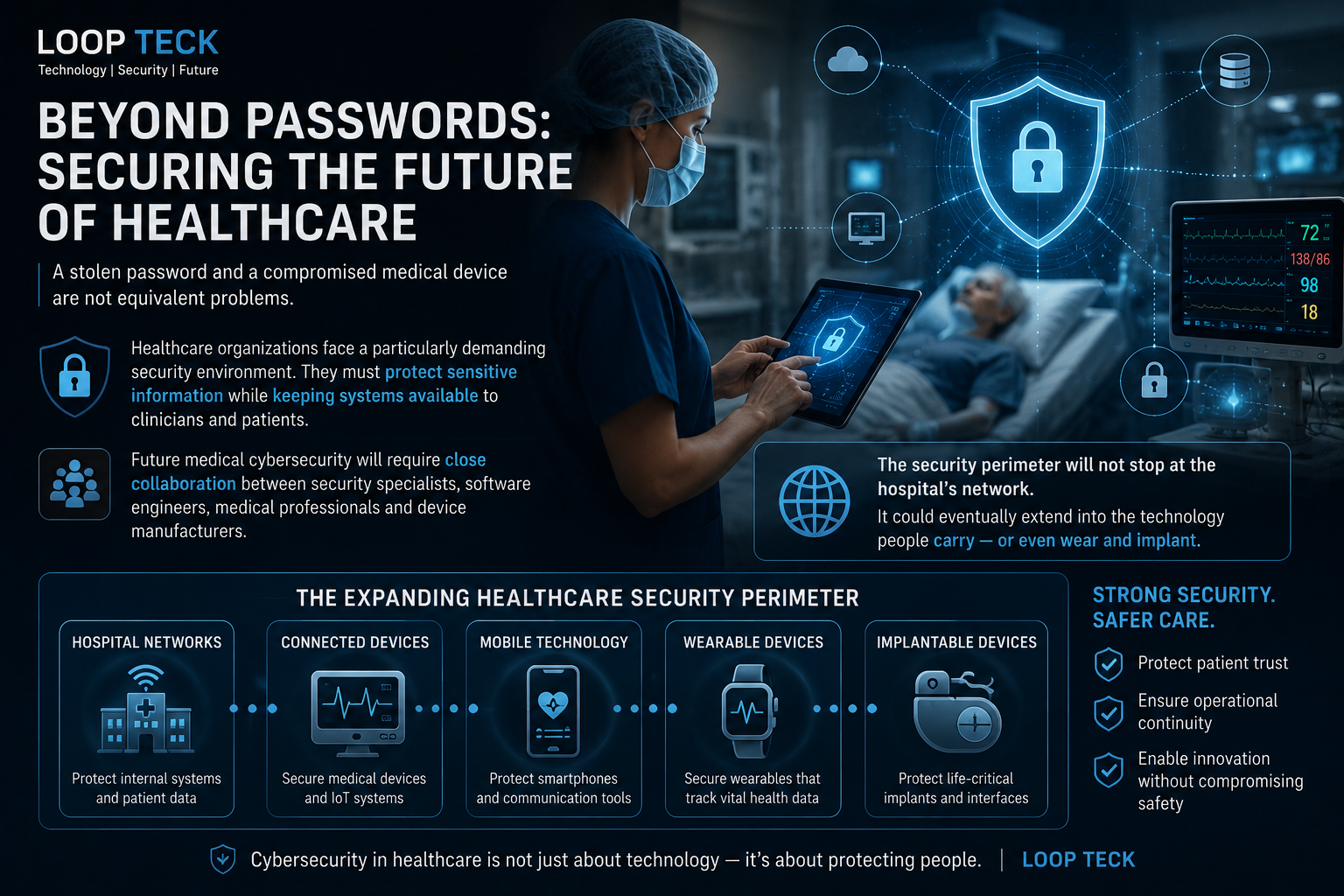
A stolen password and a compromised medical device are not equivalent problems.
Healthcare organizations therefore face a particularly demanding security environment. They must protect sensitive information while keeping systems available to clinicians and patients.
Future medical cybersecurity will likely require close collaboration between security specialists, software engineers, medical professionals and device manufacturers.
The security perimeter will not stop at the hospital’s network.
It could eventually extend into the technology people carry — or even wear and implant.
The Cybersecurity Industry Is Moving Toward Critical Infrastructure
Some of the most consequential cybersecurity battles may take place far away from consumer electronics.
Energy networks, telecommunications, transportation, water systems and manufacturing facilities increasingly depend on software and connected control systems.
These environments create unique security challenges.
A traditional office computer can often be disconnected or replaced when something goes wrong. An industrial system may be responsible for machinery that needs to operate continuously. Taking it offline can create its own operational risks.
That makes resilience increasingly important.
Organizations cannot assume that every attack will be prevented. They need systems capable of detecting intrusions quickly, containing damage and recovering operations.
This is one reason the cybersecurity industry is gradually moving beyond the idea of simply preventing breaches.
Modern security increasingly involves prevention, detection, response and recovery.
Cybersecurity Will Become an Infrastructure Requirement
As digital systems become responsible for more physical processes, cybersecurity could eventually be treated much like reliability engineering.
Nobody expects a major power network to operate without safeguards against equipment failure.
The same logic increasingly applies to software.
A connected infrastructure system that cannot tolerate compromise is inherently fragile.
The more society relies on digital technology, the more expensive that fragility becomes.
Why Cybersecurity Spending Is Unlikely to Disappear
There is also a straightforward economic reason the cybersecurity industry is likely to remain important.
Attackers have incentives.
Businesses hold valuable data. Financial systems move enormous amounts of money. Governments operate strategically important networks. Intellectual property can be worth billions. Critical infrastructure can have consequences that extend beyond a single organization.
As long as those incentives exist, there will be reasons to attack digital systems.
That does not mean every cybersecurity company will succeed.
The industry is highly competitive, technology changes quickly and today’s security products can become outdated as new attack techniques emerge. Companies such as Palo Alto Networks, CrowdStrike and IBM operate in different areas of this broader market, but their continued relevance will depend on how effectively they adapt to technologies such as AI and post-quantum cryptography.
For investors, that distinction matters.
A growing cybersecurity market does not automatically mean every cybersecurity company will be a long-term winner.
Cybersecurity’s Biggest Future Problem May Be Complexity
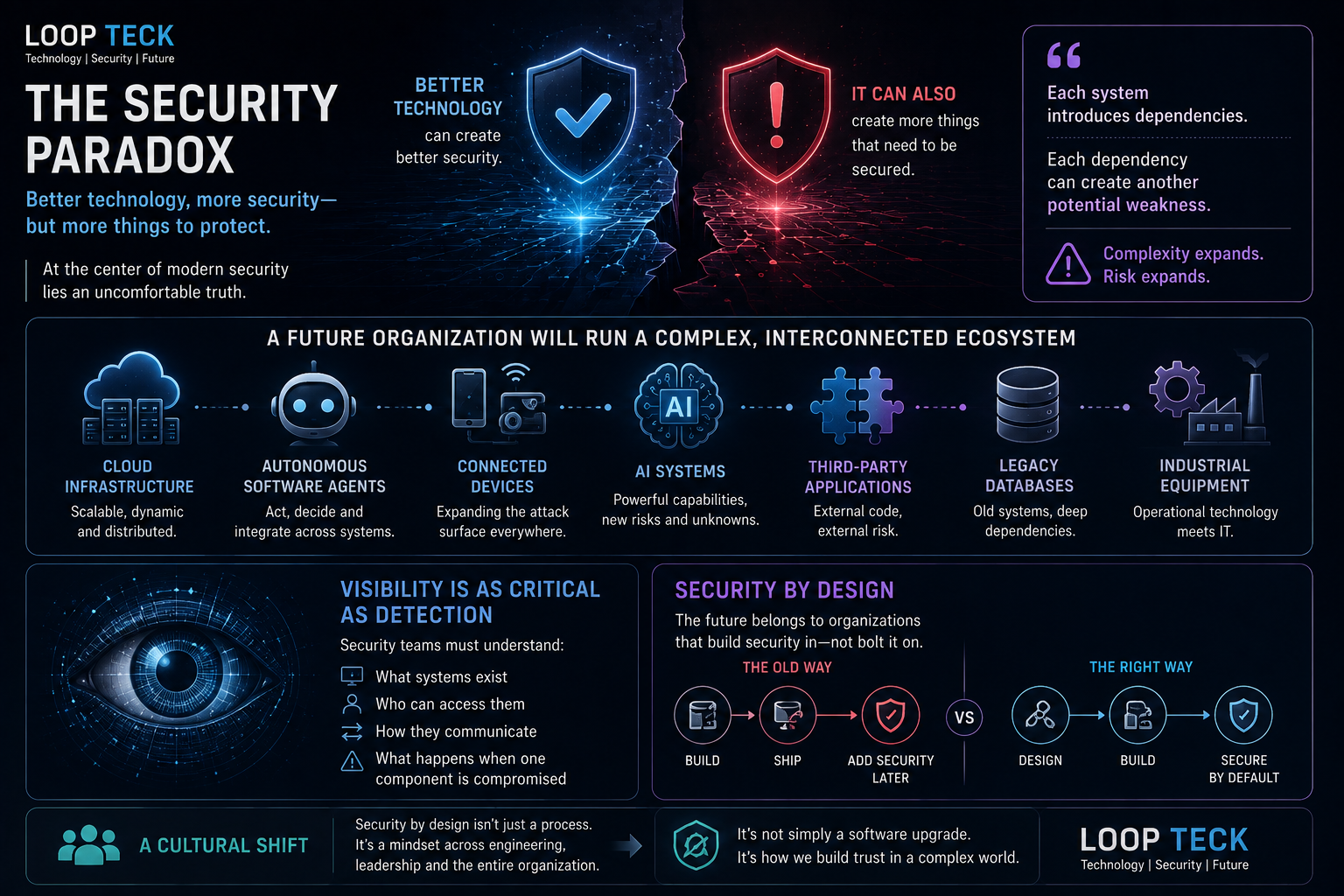
There is an uncomfortable paradox at the center of modern security.
Better technology can create better security.
It can also create more things that need to be secured.
A future organization could operate cloud infrastructure, autonomous software agents, connected devices, AI systems, third-party applications, legacy databases and industrial equipment simultaneously.
Each system introduces dependencies.
Each dependency can create another potential weakness.
That is why visibility may become just as important as detection. Security teams need to understand what systems exist, who can access them, how they communicate and what happens when one component is compromised.
Security by design will become increasingly important.
Rather than building a product and adding security afterward, developers will need to treat security as a fundamental engineering requirement from the beginning.
That is a cultural change, not simply a software upgrade.
The Future of Cybersecurity Could Be Almost Invisible
The most successful cybersecurity of the future may be the security users barely notice.
Today, people interact with cybersecurity through passwords, authentication prompts, security warnings, software updates and occasional breach notifications.
That experience could become considerably more seamless.
Authentication may become continuous rather than dependent on a single login event. Devices could automatically identify suspicious behavior and isolate themselves. Encryption could become a standard underlying property of digital communications rather than something users consciously manage.
Security could simply become part of the infrastructure.
That would represent a major shift from the early internet, when users were often expected to recognize suspicious files, choose strong passwords and install security software themselves.
The goal is not to eliminate human responsibility entirely.
It is to make the underlying systems more resilient when humans inevitably make mistakes.
Cybersecurity Will Define How Safely Technology Advances
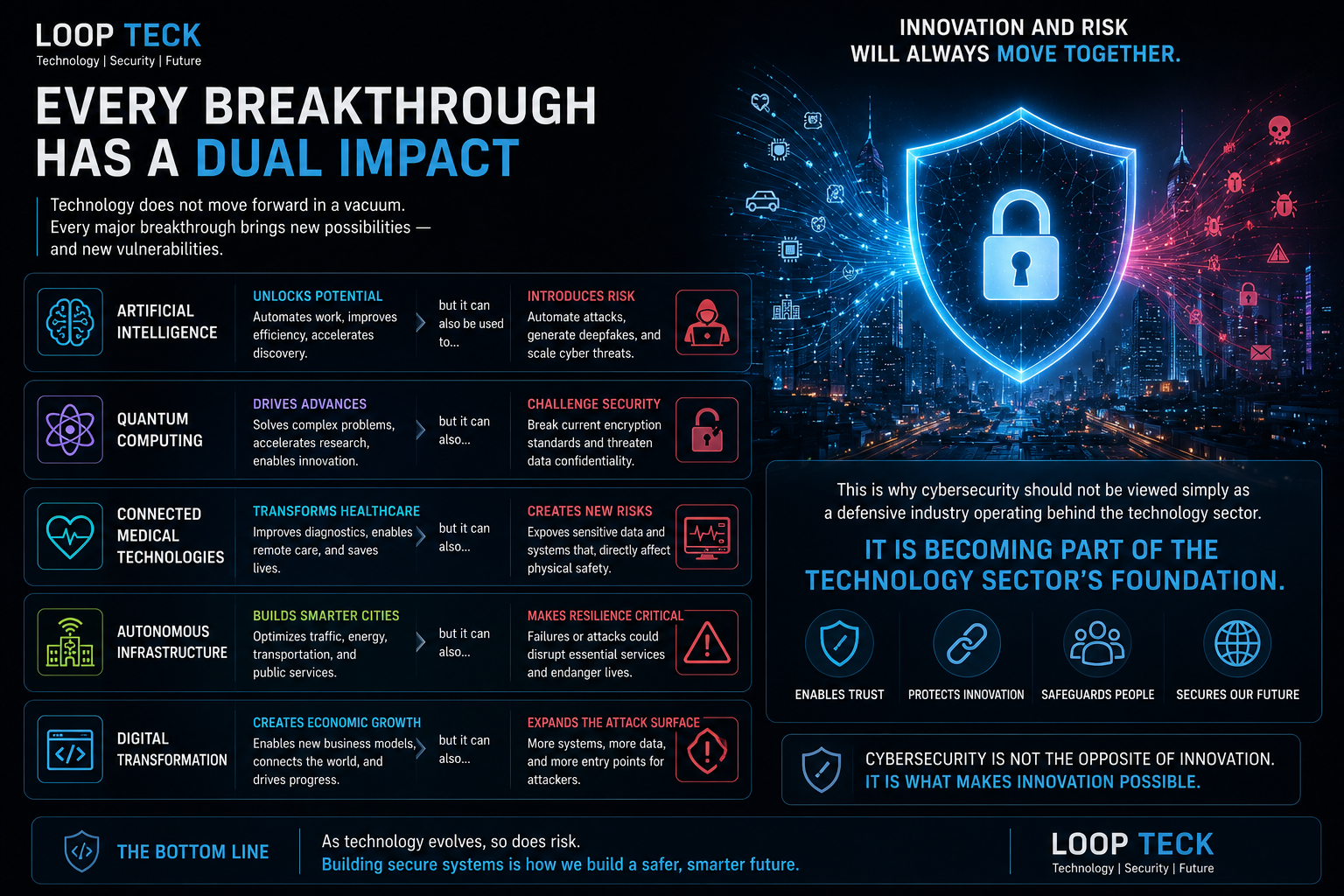
Technology does not move forward in a vacuum.
Every major technological breakthrough introduces new capabilities, but it can also create new vulnerabilities.
Artificial intelligence can automate work and accelerate discovery. It can also be used to automate attacks.
Quantum computing could unlock major scientific advances. It could also challenge existing cryptographic infrastructure.
Connected medical technologies could transform healthcare. They could simultaneously create new security risks involving systems that directly affect physical safety.
Autonomous infrastructure could make cities more efficient. It could also make digital resilience a matter of public safety.
This is why cybersecurity should not be viewed simply as a defensive industry operating behind the technology sector.
It is becoming part of the technology sector’s foundation.
The Cybersecurity Era Is Only Getting Started
There is no obvious point at which cybersecurity becomes a finished problem.
The digital environment keeps changing. New devices replace old ones. Software becomes more autonomous. Infrastructure becomes more connected. Attackers adapt. Defenders respond.
The details will change dramatically by 2050.
The underlying requirement will not.
Future security professionals may spend less time configuring traditional defenses and more time governing autonomous systems, protecting AI infrastructure, migrating cryptographic standards and securing technologies that do not yet exist at commercial scale.
That is not the disappearance of cybersecurity.
It is its expansion into almost every layer of modern technology.
The next quarter-century may therefore produce one of the industry’s biggest transformations yet: cybersecurity moving from a specialized technology function toward something closer to a permanent layer of digital civilization.
The security problem will keep changing.
That is precisely why it is unlikely to disappear.
Cybersecurity 2050
How will AI, quantum computing, connected infrastructure and emerging technology change the security systems civilization depends on? Explore the questions behind the next cybersecurity era.
Almost certainly. The reason is simple: digital technology is becoming embedded in more parts of everyday life.
By 2050, cybersecurity may protect far more than computers and websites. It could sit underneath transportation, healthcare, energy systems, autonomous machines and other critical infrastructure.
AI could dramatically increase the speed at which security teams detect and respond to threats.
Instead of relying entirely on analysts to review alerts, AI systems could correlate activity, identify anomalies and automate certain defensive responses.
The same technology could also help attackers, creating an ongoing AI arms race between offense and defense.
Some security operations could become highly autonomous, but completely removing humans would introduce another category of risk.
An automated system must know when an apparent attack is actually legitimate activity. Incorrect automated decisions could disrupt the systems they are supposed to protect.
Some encryption systems used today depend on mathematical problems that are extremely difficult for conventional computers.
A sufficiently powerful fault-tolerant quantum computer could threaten certain public-key cryptographic algorithms.
That is why organizations are preparing for the transition to post-quantum cryptography.
Post-quantum cybersecurity refers to security systems and cryptographic techniques designed to remain secure against future quantum computers.
Moving to these standards is a major infrastructure project because organizations must account for legacy applications, hardware and long-lived data.
It describes a scenario in which attackers collect encrypted information today and attempt to decrypt it in the future if sufficiently powerful technology becomes available.
This is one reason organizations handling long-lived sensitive information are paying attention to post-quantum migration now.
Healthcare increasingly depends on connected systems, electronic records, remote monitoring and software-controlled medical technology.
A security failure can therefore affect more than data. Depending on the technology involved, it can also create operational and safety risks.
Potentially. Brain-computer interfaces and other emerging technologies create increasingly direct relationships between software and biological systems.
As these technologies mature, protecting authentication, communications, software integrity and sensitive biological information could become important security considerations.
Energy, transportation, telecommunications, water and manufacturing increasingly rely on software and connected control systems.
An attack against these environments can have consequences beyond stolen information, potentially affecting physical operations and essential services.
Increasingly, security is becoming a property that needs to be designed into infrastructure rather than added afterward.
Future systems will need to detect attacks, contain damage, maintain essential operations and recover quickly when failures occur.
Passwords may become less visible as authentication becomes more continuous and increasingly relies on multiple signals.
The broader trend is toward authentication systems that can evaluate identity and behavior without forcing users to repeatedly enter credentials.
That is possible, and in many ways it is already happening.
Security features increasingly operate in the background through encryption, automated detection, identity verification and device protections.
Complexity may be one of the biggest challenges. Organizations could operate enormous ecosystems containing AI systems, cloud platforms, IoT devices, autonomous agents and legacy technology.
Knowing what exists, how systems connect and which identities can access them becomes increasingly difficult as technology expands.
Automation will likely change many security tasks, but that does not necessarily mean the profession disappears.
As machines handle repetitive analysis, professionals may move toward architecture, threat research, governance, incident strategy, AI oversight and complex investigations.
That is the central argument of this article. Technology is expanding into more areas of society rather than becoming simpler or less connected.
AI, quantum computing, autonomous systems, connected infrastructure and advanced medical technologies all create new security requirements.
The technology will change. The security problem won’t.
From autonomous AI defenses to post-quantum cryptography, the next generation of cybersecurity will be less visible, more automated and far more deeply connected to everyday life.


Loop Teck
✓Technology, AI, smartphones & the future of innovation.