


Anthropic Brings Fable 5 Back Online After Weeks of Uncertainty
Just three weeks after an unexpected suspension disrupted access for users around the world, Anthropic is bringing Fable 5 back.
Beginning July 1, the company’s newest flagship AI model will once again be available across Claude.ai, the Claude Platform, Claude Code, and Claude Cowork. The announcement follows the U.S. government’s decision to lift export controls that had temporarily restricted access to both Fable 5 and the more security-focused Mythos 5.
For developers, enterprises, and AI enthusiasts who suddenly lost access earlier this month, the reversal marks more than the return of another large language model. It highlights the increasingly complex relationship between frontier AI development, cybersecurity, and government oversight—an intersection that is likely to define the industry’s next chapter.
The brief disruption also offered a rare look inside how one of the world’s leading AI companies responds when advanced models become the subject of national security concerns.
Why Fable 5 Was Suddenly Taken Offline
Anthropic originally launched Fable 5 and Mythos 5 on June 9.
Although the two models share the same underlying architecture, they serve very different purposes.
Fable 5 was designed as the consumer-facing model, equipped with extensive safeguards intended to prevent dangerous cybersecurity misuse. Mythos 5, meanwhile, was reserved for a limited group of trusted organizations participating in Project Glasswing, where it supports advanced defensive cybersecurity research.
Only three days after launch, the U.S. government imposed export controls on both models.
The decision stemmed from research showing that Fable 5’s safety mechanisms could be bypassed under specific prompting conditions. According to Anthropic, researchers discovered a technique that allowed the model to identify software vulnerabilities and, in at least one case, generate code illustrating how a vulnerability might be exploited.
Because the export directive took effect immediately—and Anthropic had no reliable way to verify users’ nationality in real time—the company temporarily disabled access for everyone rather than risk violating federal restrictions.
It was an unusually broad response, affecting users globally regardless of where they lived.
What Changed Behind the Scenes
The restoration of Fable 5 is not simply a matter of regulatory approval.
Anthropic says it spent the past two weeks working closely with U.S. government agencies and industry partners to strengthen the model’s security systems before relaunching it.
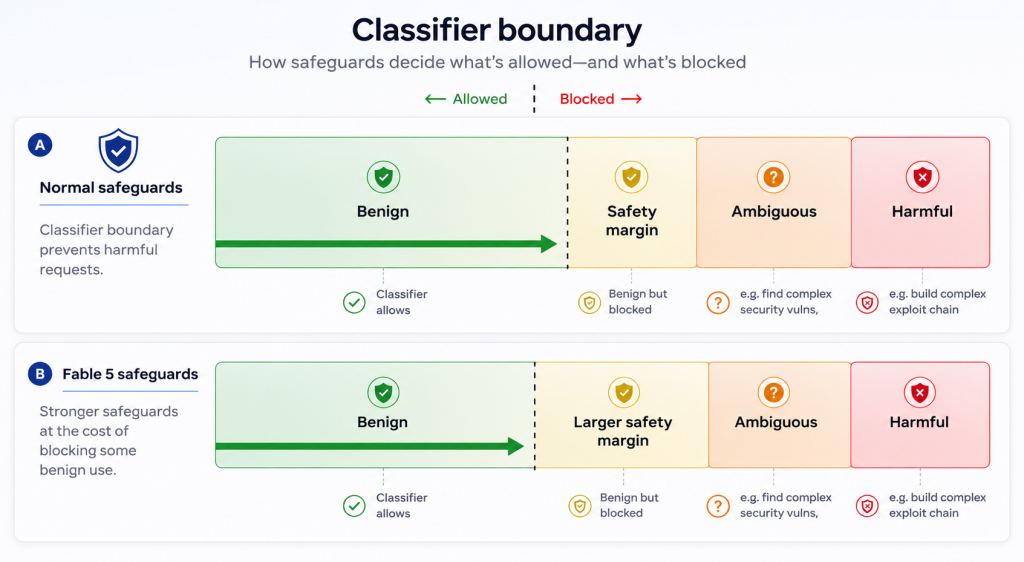
Rather than retraining the entire language model, engineers focused on improving one of its most important protective layers: AI-powered safety classifiers.
These classifiers continuously evaluate prompts during conversations, attempting to distinguish legitimate cybersecurity research from requests that could facilitate harmful activity.
The updated system specifically targets the prompting technique described in the original report.
According to Anthropic, internal testing now shows the exploit is blocked in more than 99% of attempts. When the classifier detects potentially risky behavior, users receive a notification and their request is automatically routed to Claude Opus 4.8 instead of Fable 5.
The trade-off is one many security professionals know well.
Greater protection often comes at the cost of additional false positives, meaning some legitimate coding or debugging requests may now be rejected more frequently.
Anthropic acknowledges that this will occasionally frustrate developers but argues that the balance is necessary for safely deploying increasingly capable AI systems.
The Company Says Fable 5 Was Never the Biggest Risk
One of the more revealing aspects of Anthropic’s announcement is its distinction between Fable 5 and Mythos 5.
Despite sharing the same foundation, Anthropic maintains that Fable 5 does not possess uniquely dangerous offensive cyber capabilities.
Instead, the company describes it as a heavily constrained version protected by multiple overlapping safeguards.
Mythos 5 tells a different story.
Anthropic openly states that Mythos 5 is capable of discovering and exploiting software vulnerabilities more effectively than nearly every existing AI model—and even beyond the abilities of most human cybersecurity professionals.
Those capabilities are precisely why Mythos remains available only to carefully vetted organizations working on defensive security initiatives.
The company argues that the reported bypass never exposed these higher-risk capabilities, making the original findings less severe than they initially appeared.
Even so, Anthropic treated the report as a critical opportunity to improve its defenses before restoring public access.
A Broader Industry Problem: AI Jailbreaks
Perhaps the biggest takeaway extends beyond Fable 5 itself.
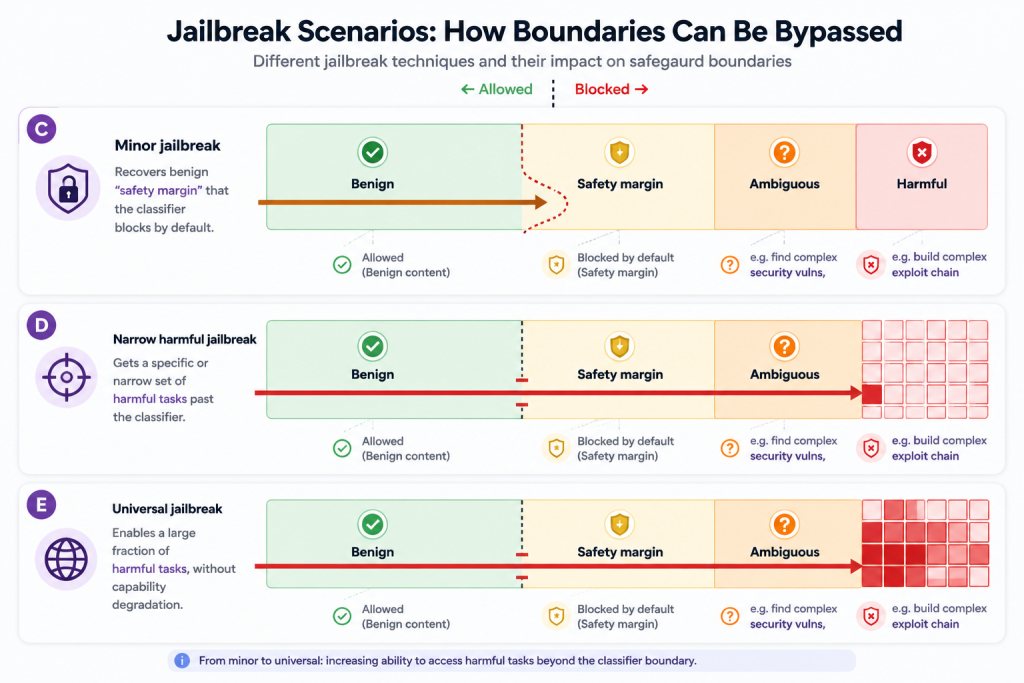
Anthropic believes the AI industry lacks a consistent way to evaluate so-called “jailbreaks”—techniques that circumvent a model’s built-in safety systems.
Today, companies often describe jailbreaks using different terminology and different standards of severity.
That inconsistency creates confusion for developers, researchers, policymakers, and even governments trying to assess how serious a newly discovered vulnerability actually is.
To address that gap, Anthropic says it has begun collaborating with major technology companies including Amazon, Microsoft, and Google to develop a shared framework for evaluating AI jailbreaks.
The proposal would measure incidents across four dimensions:
- How much new capability the jailbreak unlocks.
- How broadly it works across different tasks.
- How easily attackers can weaponize it.
- How widely the technique can be discovered or replicated.
The objective is to establish an industry-wide language for discussing AI security risks, similar to how the Common Vulnerability Scoring System (CVSS) standardized software vulnerability assessment decades ago.
Anthropic Wants Governments More Involved in Frontier AI
The temporary shutdown of Fable 5 didn’t just expose weaknesses in AI safeguards—it also accelerated a broader shift in how Anthropic intends to work with governments.
In its latest announcement, the company outlined a significant expansion of its collaboration with U.S. agencies responsible for cybersecurity, national security, and AI policy. Rather than treating regulators as outside observers, Anthropic says future frontier models will undergo more structured evaluation before reaching the public.
That includes granting designated government partners early access to advanced models and their accompanying safety systems, allowing independent testing before wider deployment.
It’s a notable departure from the software industry’s traditional release cycle, where products are often launched first and patched later. For frontier AI, Anthropic argues that pre-release evaluation is becoming a necessity rather than an option.
The company also plans to share threat intelligence more quickly, coordinate responses to newly discovered jailbreak techniques, and dedicate engineering resources to joint AI security research with government partners.
Taken together, the measures signal that frontier AI is beginning to resemble critical infrastructure—technology whose deployment increasingly involves public institutions alongside private companies.
Why This Matters Beyond Anthropic
Although the announcement focuses on Fable 5, its implications stretch far beyond a single model.
The incident demonstrated how quickly governments are willing to intervene when advanced AI systems raise cybersecurity concerns. Just days after launch, export controls effectively removed one of the industry’s newest flagship models from global availability.
That kind of response would have been difficult to imagine only a few years ago.
Today, however, increasingly capable AI models are no longer viewed solely as productivity tools or research assistants. They are also being evaluated through the lens of national security, critical infrastructure protection, and offensive cyber capabilities.
For AI developers, that means technical innovation is no longer the only challenge.
Future releases will likely face growing scrutiny over safety testing, misuse prevention, regulatory compliance, and transparency around model capabilities. Companies able to demonstrate robust safeguards may find themselves better positioned as governments develop more formal oversight frameworks.
What Developers and Enterprise Customers Should Know
For most users, the immediate impact is straightforward: Fable 5 is returning.
Beginning July 1, the model will once again be available globally across Claude.ai, the Claude Platform, Claude Code, and Claude Cowork. Anthropic also says it is working to restore access through major cloud providers—including AWS, Google Cloud, and Microsoft Foundry—as quickly as possible.
Subscription tiers will see slightly different rollout conditions.
Users on Pro, Max, Team, and certain Enterprise plans will receive Fable 5 as part of their weekly usage allowance through July 7. After that date, usage will transition to a credit-based system, with Enterprise customers required to enable usage credits to continue accessing the model.
Developers may also notice changes in day-to-day interactions.
Because Anthropic has expanded its safety classifiers, some legitimate programming or debugging requests could now trigger protective measures more frequently than before. Requests identified as potentially risky may be redirected to Claude Opus 4.8 instead of Fable 5.
While this may occasionally interrupt workflows, Anthropic says the updated safeguards are designed to reduce opportunities for malicious exploitation without significantly affecting normal development tasks.
The Bigger Debate: Can AI Ever Be Completely Secure?
Perhaps the most candid part of Anthropic’s announcement is its acknowledgment that perfect AI security may be unattainable.
The company compares AI jailbreaks to software vulnerabilities. Just as no operating system or application is completely free of security flaws, large language models are unlikely to become entirely resistant to prompt-based attacks.
Instead of promising absolute protection, Anthropic advocates for a layered security strategy.
That approach combines multiple defenses—including model training, behavioral safeguards, AI-powered classifiers, post-deployment monitoring, and rapid response mechanisms—to reduce risk even when individual protections are bypassed.
Security professionals often describe this philosophy as “defense in depth,” and it has long been a cornerstone of cybersecurity.
Applying the same principle to generative AI reflects an important shift in industry thinking. Rather than expecting any single safeguard to eliminate misuse, developers are increasingly building systems that assume attacks will occur and focus on limiting their impact.
Editorial Analysis: A Turning Point for Frontier AI
The return of Fable 5 represents more than the restoration of a popular AI model.
It offers one of the clearest examples yet of how frontier AI development is evolving into a collaborative effort involving technology companies, security researchers, cloud providers, and governments.
Only weeks ago, the conversation centered on whether a model’s safeguards had been bypassed.
Today, it has expanded to include export controls, national security policy, standardized jailbreak reporting, coordinated vulnerability response, and pre-release government evaluation.
That evolution suggests the next generation of AI competition won’t be defined solely by larger context windows, faster inference speeds, or benchmark performance.
Trust, transparency, and demonstrable safety are becoming competitive advantages in their own right.
For Anthropic, restoring Fable 5 closes one chapter. More importantly, it opens another—one in which the race to build the world’s most capable AI models is increasingly matched by the challenge of deploying them responsibly.
As governments refine regulations and AI capabilities continue to advance, the Fable 5 episode may be remembered as an early milestone in defining how frontier AI reaches the public.


Loop Teck
Future Technology • AI • Smartphones • Innovation