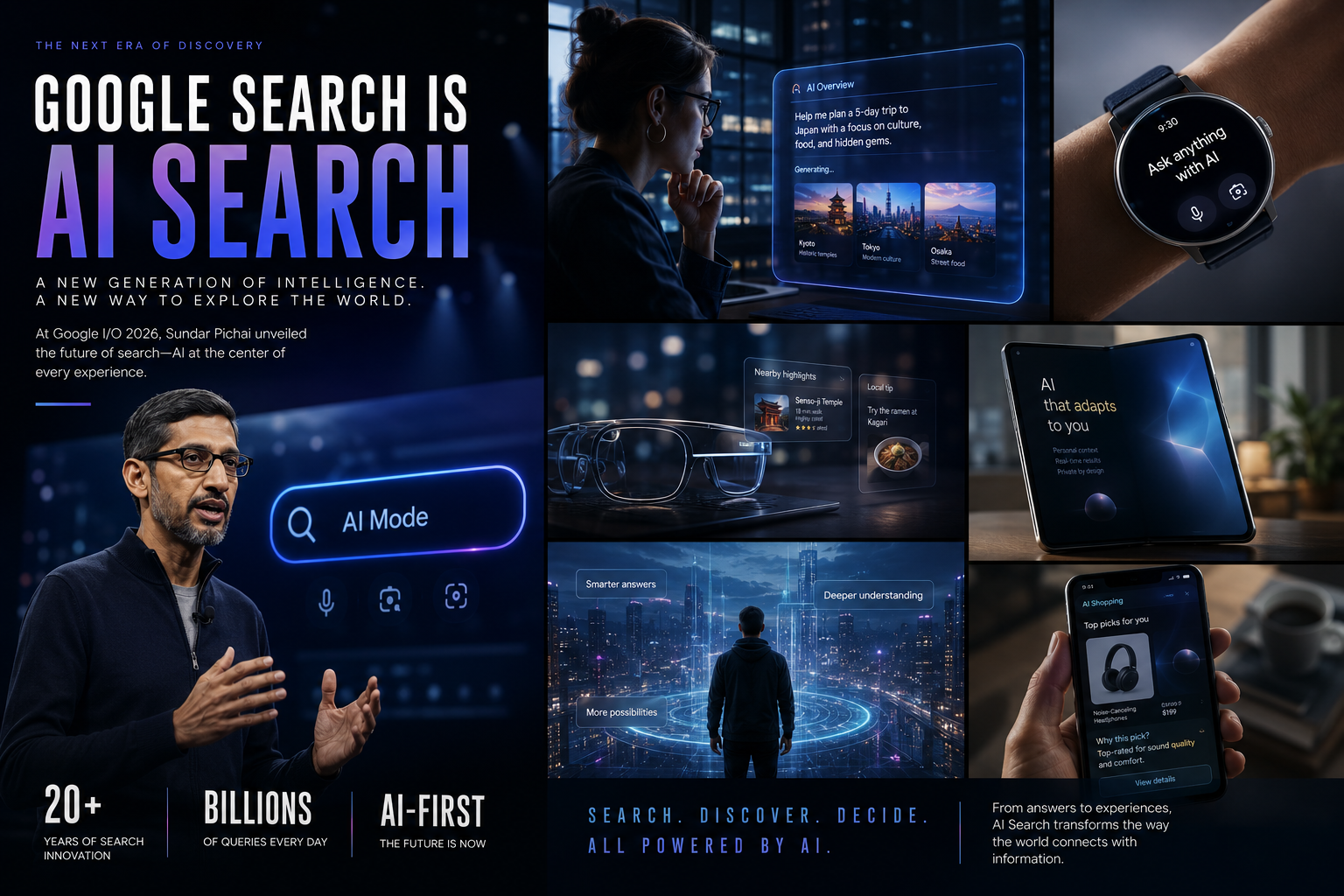




Google has spent more than two decades refining the world’s most popular search engine. Now, the company is making its boldest move yet.
At Google I/O 2026, CEO Sundar Pichai delivered a message that immediately grabbed the attention of the technology industry:
“Google Search is AI Search.”
It wasn’t just another product update. It signaled a fundamental shift in how billions of people will discover information online in the years ahead. Google’s latest announcements reveal a future in which artificial intelligence sits at the center of every search experience, transforming how users ask questions, receive answers, shop, learn, and interact with the web.
For consumers, the change promises convenience and speed. For publishers, marketers, and content creators, it could redefine the rules of online visibility.
And the transformation has already begun.
Why Google Is Betting Everything on AI Search
The rise of generative AI has dramatically changed user expectations.
Instead of scrolling through pages of blue links, people increasingly want direct answers, personalized recommendations, and intelligent assistance. Chatbots and AI assistants have accelerated this shift, forcing search companies to rethink their products from the ground up.
Google’s response is ambitious.
The company announced that AI Search will now serve as the foundation of its search ecosystem. AI-generated responses, multimodal interactions, intelligent recommendations, and autonomous digital assistants are becoming core parts of the search experience.
This isn’t simply an enhancement.
It’s a redesign of how search works.
The Biggest Search Upgrade in Decades
According to Google, the search box itself is receiving its largest upgrade in more than 25 years.
Users will no longer rely solely on typed text. The new experience allows people to search using images, videos, documents, browser tabs, and voice interactions.
Google’s AI can understand context across multiple formats and provide richer answers that feel more conversational and useful.
The goal is simple: reduce the effort required to find information while increasing the relevance of every result.
For everyday users, this means less searching and more solving.
Gemini Is Powering the New Era
At the center of Google’s strategy is Gemini 3.5 Flash.
The model powers many of the new AI experiences across Search and Google’s broader ecosystem. Google says the technology combines advanced reasoning with action-oriented capabilities, allowing AI systems to move beyond answering questions and begin completing tasks.
That distinction matters.
Traditional search engines deliver information.
The next generation of AI Search aims to help users achieve outcomes.
Need help planning a trip?
Searching for the best laptop?
Researching a complex topic?
Google wants its AI systems to handle much of the heavy lifting.
The Rise of Search Agents
One of the most intriguing announcements from Google I/O involved intelligent agents.
These AI-powered assistants can monitor information, track updates, and perform ongoing tasks on behalf of users.
Imagine setting an AI agent to watch product prices, monitor stock movements, follow industry developments, or alert you when tickets become available.
Instead of repeatedly searching, users can delegate tasks and receive updates automatically.
This represents a major evolution in how people interact with information online.
What This Means for Publishers and Content Creators
The shift toward AI Search creates both opportunities and challenges.
For years, websites competed for clicks through traditional search rankings.
Now, AI-generated summaries may answer many user questions before a visitor ever clicks a link.
That possibility has sparked concern throughout the publishing industry.
Traffic patterns could change dramatically.
At the same time, high-quality content remains essential because AI systems still rely on trusted information sources to generate accurate responses.
The websites that focus on expertise, credibility, originality, and user value are likely to remain important contributors to the information ecosystem.
The challenge isn’t disappearing from search.
It’s adapting to a search environment that increasingly prioritizes answers over links.
Why Businesses Should Pay Attention
This transition extends far beyond technology companies.
Every business with an online presence will feel the effects.
Brands may need to rethink content strategies, customer engagement tactics, and visibility goals.
Instead of optimizing solely for traditional rankings, organizations will need to consider how their information appears within AI-generated experiences.
Clear expertise, authoritative content, structured information, and trustworthy sources are becoming more important than ever.
Companies that adapt early could gain a significant advantage as AI-driven discovery becomes mainstream.
The Competition Is Intensifying
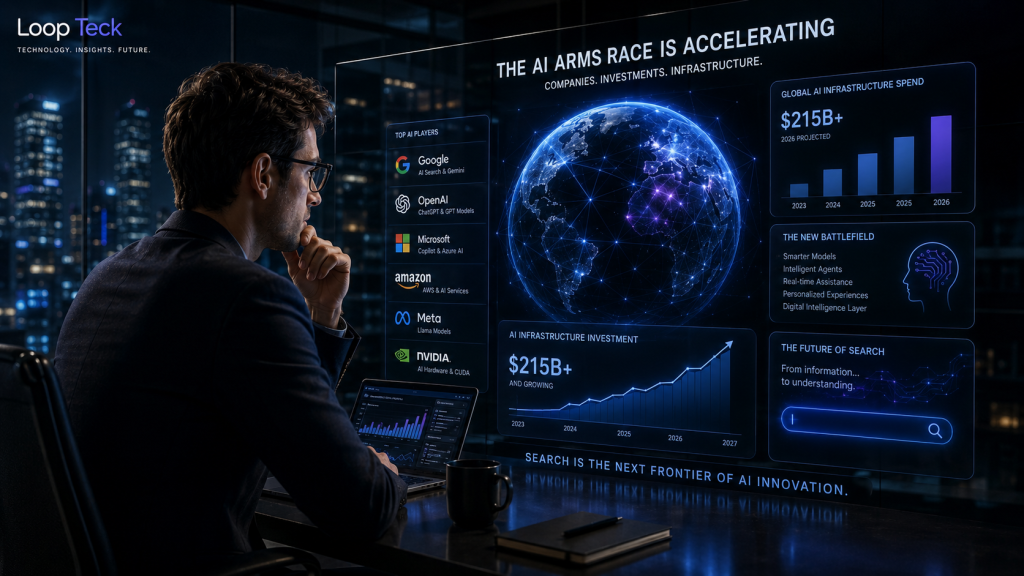
Google’s announcement also highlights the growing AI arms race across the technology sector.
Major players continue to invest billions in artificial intelligence infrastructure, advanced models, and agent-based systems. Industry spending on AI infrastructure is reaching unprecedented levels as companies compete to define the next generation of digital experiences.
Search is no longer just about indexing websites.
It’s becoming a battle to build the most useful digital intelligence layer for everyday life.
That battle is accelerating rapidly.
A Future Where Search Feels Invisible
Perhaps the most interesting aspect of AI Search is what it suggests about the future.
Searching may eventually become less visible.
Instead of actively seeking information, users could interact with AI systems that anticipate needs, surface relevant insights, and complete tasks proactively.
The search engine evolves into an intelligent assistant.
The browser becomes a workspace.
The internet becomes a conversation.
Whether that future excites or concerns you, one thing is clear: Google has officially committed to making AI the foundation of search.
The ripple effects will shape technology, business, publishing, and digital culture for years to come.
For now, one message from Google I/O stands above all others:
Search is entering a completely new era, and AI Search is leading the way.
AI Search Is
Changing Google Forever
Google’s AI-powered search revolution is reshaping how billions of people discover information, interact with websites, and experience the internet.
AI Search uses advanced artificial intelligence to understand questions, analyze intent, and generate direct answers. Instead of relying solely on a list of links, Google can now provide conversational responses, summaries, and recommendations that help users find information faster.
Google believes artificial intelligence represents the future of information discovery. As users increasingly expect instant answers and personalized assistance, AI Search allows Google to deliver smarter experiences while remaining competitive in the rapidly evolving AI industry.
Gemini is Google’s flagship AI model that powers many of the company’s latest search features. It helps Search understand complex questions, process multiple content formats, and generate intelligent responses that feel more natural and helpful.
AI search agents can perform tasks on behalf of users, including monitoring prices, tracking updates, researching products, and gathering information automatically. They represent a major shift from passive searching to proactive digital assistance.
AI Search is changing how users interact with content online. Publishers will need to focus on expertise, credibility, original reporting, and user-focused content as Google increasingly integrates AI-generated answers into the search experience.
Loop Teck
Future Technology • AI • Smartphones • Innovation