

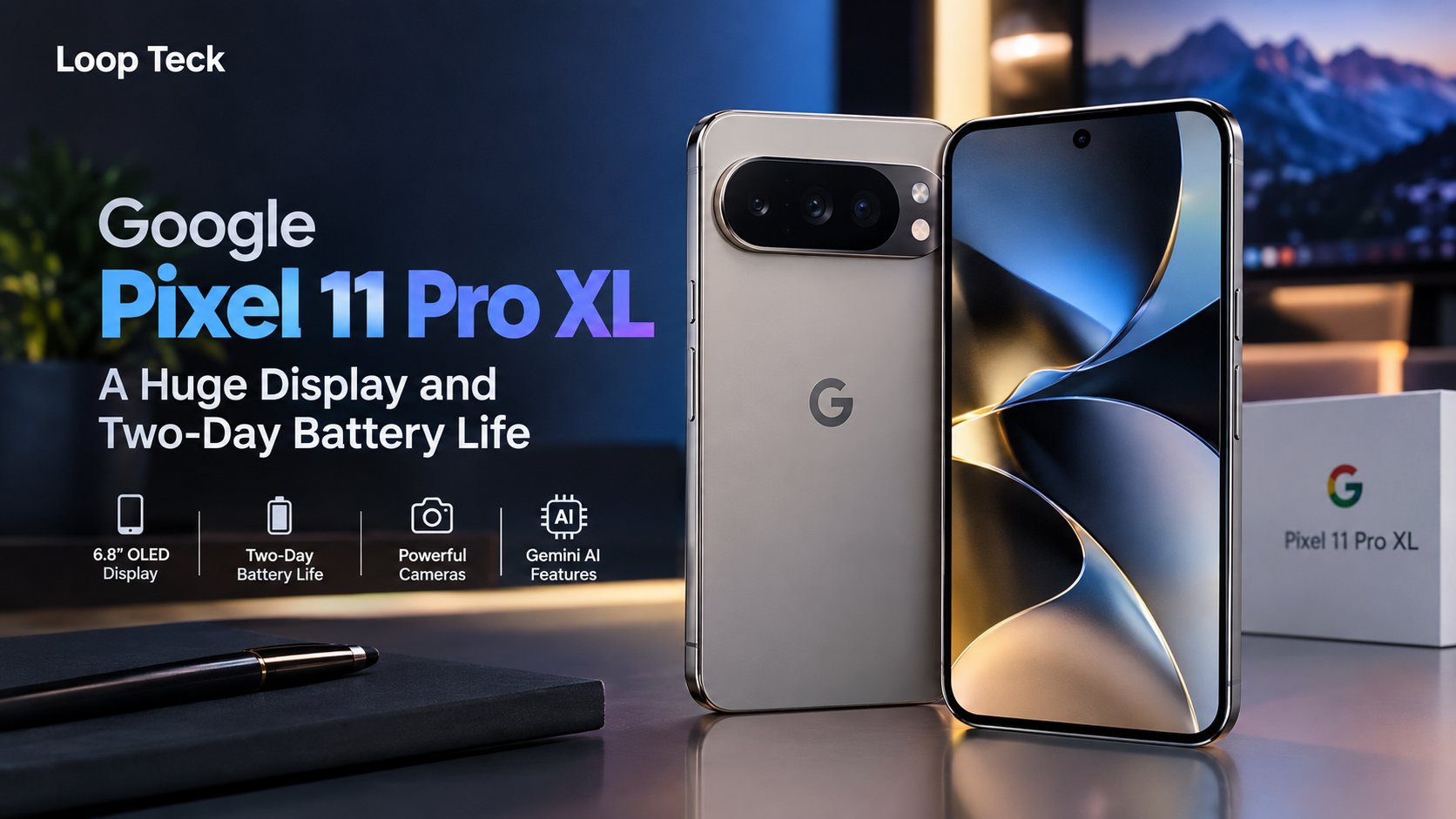
The Pixel 11 Pro XL is Google’s answer to people who want a flagship phone without compromising on screen size or battery capacity. Its 6.8-inch OLED display gives the phone an expansive canvas for video, photos and apps, while its large battery can last almost two days under mixed real-world use.
That makes Google’s biggest 2026 Pixel a direct competitor to other oversized premium phones, including Apple’s iPhone 18 Pro Max and Samsung’s Galaxy S26 Ultra.
The price is equally premium. The Pixel 11 Pro XL starts at $1,299 in the U.S., while the phone also introduces a familiar compromise: Google has reduced memory on some configurations compared with the previous generation.
The bigger question, therefore, is not whether the Pixel 11 Pro XL is powerful enough for everyday use. It is whether its excellent camera system, long battery life, large display and increasingly capable local AI features justify its place among the most expensive smartphones on the market.
The Pixel 11 Pro XL is built around its enormous 6.8-inch display
The defining feature of the Pixel 11 Pro XL is its screen. Google uses a 6.8-inch 120Hz QHD+ OLED panel with a pixel density of 486ppi.
That makes the XL substantially more focused on large-screen use than the regular Pixel 11 Pro. Video benefits especially from the extra space, while the large panel also makes photography, browsing and multitasking more comfortable.
Google has not radically redesigned the hardware formula. The phone still combines polished aluminum sides with a glass rear panel and the company’s distinctive camera bar.
However, the 2026 model is slightly more compact than its predecessor. Google has reduced the dimensions by 0.1mm in each direction, while the phone weighs 6g less than the Pixel 10 Pro XL.
At 226g, though, this remains a substantial smartphone.
The size matters in daily use. One-handed operation can be difficult, particularly when reaching across the upper portion of the display. For people who regularly watch widescreen video or prefer a large keyboard, the trade-off is easier to accept.
A smaller body does not make it a small phone
The Pixel 11 Pro XL measures 162.7 x 76.5 x 8.5mm.
That places it firmly in the large-phone category. Its weight and width mean it will often require two hands, especially when typing or using the camera.
In return, users get a large viewing area without moving to Google’s foldable form factor.
The rear also retains Google’s HiLight LED. It can illuminate when interacting with Gemini or when a selected contact calls, although its practical value remains limited.
Battery life is one of the Pixel 11 Pro XL’s biggest advantages
Battery endurance is arguably the most important hardware improvement for people considering the XL model.
The Pixel 11 Pro XL can last about two days between charges under the tested usage pattern. That included more than six hours of active screen time across 5G and Wi-Fi while browsing, messaging, using apps and taking photos.
That is several hours longer than the regular Pixel 11 Pro in the same review.
It also means most owners should not need to charge the phone every night under lighter or moderate workloads.
There is a catch. The previous-generation XL reportedly lasted slightly longer under the same testing conditions. So the new model improves the experience over the smaller Pixel 11 Pro without establishing a clear generational leap in endurance.
Charging remains relatively slow for a premium flagship
The Pixel 11 Pro XL supports wired charging through USB-C and wireless charging through Qi2.
A full wired charge takes roughly 90 minutes with a 45W-or-faster USB-C power adapter.
The charger is not included.
Wireless charging takes longer, although the phone supports 25W Qi2-class wireless charging and magnetic accessories.
For users who value overnight charging, the charging speed may matter less because the battery can comfortably stretch into a second day.
The Pixel 11 Pro XL camera system is its strongest creative tool
Google has equipped the XL with the same triple-camera system found on the regular Pixel 11 Pro.
The rear setup consists of:
50MP wide camera
48MP ultrawide camera
48MP 5x telephoto camera
42MP front-facing camera
The combination gives the Pixel 11 Pro XL a flexible photographic range without relying solely on computational cropping.
The 5x telephoto camera is particularly useful for distant subjects. Google’s processing can extend the usable zoom range further, with the camera delivering a strong 10x crop zoom and digital magnification reaching 30x before generative AI processing can extend it to as much as 120x.
That extreme range is more about computational photography than conventional optical magnification.
Night Sight gets substantially faster
Google has also focused on reducing the delay associated with low-light photography.
The new Night Sight mode captures images roughly three to four times faster while improving detail and sharpness.
That change matters because computational night photography can become frustrating when subjects move during a long capture sequence.
A faster capture process should make Night Sight more practical for people photographing people, pets or spontaneous scenes after dark.
Camera Looks adds more creative control
Google has also introduced Camera Looks, which changes how the Pixel processes photographs.
The important point is that Google is not presenting every processing change as a technical improvement. Some Looks can intentionally make images appear less technically accurate in exchange for a different visual character.
That gives photographers more control over the final appearance without requiring traditional manual editing.
The phone also introduces Magic Capture, which can automatically capture photos and video with a single press.
For social-media creators, Google’s Creator Suite adds additional tools aimed at producing and editing social video.
Tensor G6 keeps the Pixel fast, but not at the top of the performance chart
The Pixel 11 Pro XL uses Google’s Tensor G6 processor.
In everyday use, the phone feels highly responsive. Apps, messaging, browsing and photography should not present a problem for the hardware.
Gaming tells a different story.
The Tensor G6 can handle mid-level gaming, but its raw performance does not match the highest-performing chips found in competing flagship phones.
That distinction is important.
A buyer who primarily wants a fast everyday Android phone will get a responsive experience. A user who prioritizes maximum frame rates, demanding graphics settings or sustained gaming performance may find the Pixel less compelling.
Memory configurations have changed
RAM.
Storage.
Choice.
The Pixel 11 Pro XL comes with either 12GB or 16GB of RAM, depending on configuration. Storage options include 256GB, 512GB and 1TB.
Storage option
RAMageddon
enters the configuration.
The review notes that Google has reduced memory on some configurations compared with the previous generation. The change is connected to higher memory costs, described in the source review as part of the broader “RAMageddon” situation. That makes storage and memory configuration something buyers should examine carefully before purchasing.
Android 17 and Gemini push the Pixel beyond conventional smartphone features
The Pixel 11 Pro XL ships with Android 17 and is supported through August 2033.
Google’s software remains one of the phone’s defining strengths. The interface is polished, while several AI features run locally on the device.
The review highlights proactive Gemini suggestions as one of the more useful additions.
Instead of treating AI as a separate chatbot experience, Google is integrating it into the broader phone experience.
The keyboard also gains the upgraded Rambler voice dictation system, which is designed to make voice input faster and more capable.
The phone additionally includes six months of Google AI Pro.
That subscription provides access to higher AI usage limits, 5TB of cloud storage, Gemini Omni for video generation and Google Health Premium.
For buyers already invested in Google’s ecosystem, these extras add more value to the overall package.
The Pixel 11 Pro XL has strong long-term repair and sustainability credentials
Google has continued to emphasize repairability.
The Pixel 11 Pro XL can be serviced by Google, third-party repair shops or through self-repair. Google also provides manuals and replacement parts.
The battery is rated for more than 1,000 full charge cycles while retaining at least 80% of its original capacity.
The phone also contains 33% recycled material by weight.
Google provides an environmental impact report and offers recycling for old devices.
These details will not determine the phone’s performance, but they matter for buyers who intend to keep a flagship for several years rather than replace it quickly.
Pixel 11 Pro XL specifications at a glance
Pixel 11
Pro XL.
A bigger, more cinematic editorial treatment built around the Pixel identity: a huge phone hero, a true centered punch-hole, the signature rear camera bar, and every headline spec kept visible instead of buried inside the artwork.
INTELLIGENCE LAYER
The lens stack,
not a spec footnote.
Tap a camera to highlight the corresponding physical lens. The visual hierarchy makes the three-camera system obvious before the reader even reaches the text.
High-resolution front camera placed in a true punch-hole display treatment.
A full stack
of always-on links.
The connectivity story is displayed as a dense but legible chip cloud, with the long support runway given its own visual weight.
Through August 2033, according to the supplied specification brief.
Everything visible.
Nothing hidden.
Core facts are turned into compact editorial cards so the component remains readable inside a normal article instead of taking over the entire page.
120Hz QHD+ OLED · 486ppi
Google Tensor G6
Selected: 12GB
Selected: 256GB
50MP + 48MP ultrawide + 48MP 5× telephoto
Front-facing camera in a centered punch-hole display.
Large XL chassis.
Listed device weight.
Protection rating from the brief.
Qi2 up to 25W.
U.S. configuration listed as eSIM-only.
Software support through August 2033.
Pixel 11 Pro XL — Full Specification Board
| Display | 6.8-inch 120Hz QHD+ OLED |
| Pixel density | 486ppi |
| Processor | Google Tensor G6 |
| RAM | 12GB or 16GB |
| Storage | 256GB, 512GB, 1TB |
| Rear camera | 50MP + 48MP ultrawide + 48MP 5x telephoto |
| Front camera | 42MP |
| Operating system | Android 17 |
| Connectivity | 5G, eSIM, Wi‑Fi 7, UWB, NFC, Bluetooth 6, Thread, GNSS |
| Water resistance | IP68 |
| Dimensions | 162.7 × 76.5 × 8.5mm |
| Weight | 226g |
| Wireless charging | Qi2, up to 25W |
| U.S. SIM | eSIM only |
| Software support | Through August 2033 |
U.S. buyers should pay attention to the SIM configuration
There is a regional hardware difference that matters specifically to U.S. buyers.
Models sold in the United States do not include a physical SIM card slot. They rely entirely on eSIM.
Models sold in the UK, European Union and Australia retain a physical SIM slot.
That distinction is easy to overlook when comparing specifications across international reviews.
For most U.S. buyers, eSIM support should not create a major obstacle. However, anyone who regularly swaps physical SIM cards should account for the hardware difference before purchasing.
How the Pixel 11 Pro XL compares with the biggest flagship phones
The Pixel 11 Pro XL enters a crowded premium-phone segment.
Its starting price is $1,299 in the United States.
The phone competes directly with Apple’s iPhone 18 Pro Max and Samsung’s Galaxy S26 Ultra, while Google’s own lineup positions the Pixel 11 Pro below it at a lower price.
The key difference is how each device prioritizes hardware.
The Pixel emphasizes photography, computational imaging, Google’s software experience, local AI and battery endurance.
Samsung’s competing Ultra-class phone targets users who prioritize raw performance and power-user features.
Apple’s largest Pro model competes through its own hardware and software ecosystem.
That makes the Pixel 11 Pro XL less about having the highest specification in every category and more about combining Google’s strengths into one very large device.
The biggest compromises are size, price and raw performance
The Pixel 11 Pro XL’s strengths also reveal its limitations.
The 6.8-inch display is excellent, but it contributes to the phone’s large physical footprint.
The battery is excellent, but charging remains a roughly 90-minute process with an appropriate wired adapter.
The cameras are highly capable, but Tensor G6 does not lead the field in raw performance.
The AI features are extensive, but some of the most useful capabilities are tied to Google’s broader services and subscriptions.
And the $1,299 starting price puts the phone firmly in premium flagship territory.
This is not a phone designed around a single headline specification. It is Google’s attempt to make its entire Pixel experience work at the largest possible scale.
Practical Takeaway
The Pixel 11 Pro XL is a large-screen flagship built around three clear priorities: display quality, camera capability and endurance.
Its 6.8-inch OLED gives users a substantial canvas, while the battery can approach two days under the tested usage pattern. The camera system adds a 5x telephoto lens, strong computational photography and a wider set of creative controls.
Google’s Tensor G6 also makes the phone feel fast in normal use. However, it does not compete at the very top of the raw performance hierarchy, particularly for demanding gaming.
That leaves the Pixel 11 Pro XL with a clearly defined identity.
It is a premium Google phone for people who want a huge screen, long battery life, sophisticated cameras and deeply integrated AI. Its size, price and performance limitations are equally important parts of the buying decision.
At $1,299, the Pixel 11 Pro XL is not simply a larger Pixel 11 Pro. It is Google’s most expansive expression of the Pixel platform, with the hardware scale to match its increasingly ambitious software.
Pixel 11 Pro XL FAQ
Everything you need to know about Google’s big-screen flagship, including its display, battery life, cameras, Tensor G6 chip, Android 17, AI features, charging and U.S. SIM support.
The Pixel 11 Pro XL is Google’s large-screen flagship for 2026. It combines a 6.8-inch 120Hz QHD+ OLED display, Tensor G6 processor, a triple rear-camera system, a large battery and Google’s latest Android 17 and Gemini AI features.
The Pixel 11 Pro XL has a 6.8-inch QHD+ OLED display with a 120Hz refresh rate and 486ppi pixel density. Its large panel is particularly suited to video, photography, browsing and other activities that benefit from additional screen space.
The Pixel 11 Pro XL can last about two days between charges under the tested usage pattern. The test included more than six hours of active screen time across 5G and Wi-Fi for browsing, messaging, apps and photography.
The rear camera system includes a 50MP wide camera, 48MP ultrawide camera and 48MP 5x telephoto camera. A 42MP selfie camera handles front-facing photography and video calls.
The 5x telephoto camera can produce an excellent 10x crop zoom. Digital zoom extends to 30x, while Google’s generative AI processing can take magnification as high as 120x.
A full wired charge takes about 90 minutes using a 45W-or-faster USB-C power adapter. The adapter is not included. The phone also supports 25W Qi2 wireless charging and magnetic accessories.
The Pixel 11 Pro XL uses Google’s Tensor G6 processor. It provides responsive everyday performance and can handle mid-level gaming, although its raw performance falls short of the highest-performing chips in competing flagship phones.
The Pixel 11 Pro XL is available with 12GB or 16GB of RAM. Storage options are 256GB, 512GB and 1TB. The review also notes that some configurations have less memory than the previous generation.
The Pixel 11 Pro XL runs Android 17. Software support is listed through August 2033, giving the phone a long support window.
Google’s Pixel 11 Pro XL includes several AI-focused features, including proactive Gemini suggestions, upgraded Rambler voice dictation, Gemini Omni through Google AI Pro and generative AI-assisted camera features. The phone also includes six months of Google AI Pro.
It depends on the market. The U.S. version relies entirely on eSIM and does not include a physical SIM card slot. Models sold in the UK, European Union and Australia retain a physical SIM slot.
The Pixel 11 Pro XL starts at $1,299 in the United States. The source review lists pricing of £1,279 in the UK, €1,399 in Europe and A$2,099 in Australia.
Yes. The Pixel 11 Pro XL carries an IP68 water-resistance rating. The supplied specifications list resistance at up to 1.5 meters for 30 minutes.
Yes. The Pixel 11 Pro XL supports Qi2 wireless charging at up to 25W and magnetic accessory support. Wired charging uses the phone’s USB-C port.
The Pixel 11 Pro XL can handle mid-level gaming, but its Tensor G6 processor does not match the raw performance of the highest-performing chips in competing flagship phones. Users focused on maximum frame rates and graphics performance may want to consider that limitation.


Loop Teck
✓Technology, AI, smartphones & the future of innovation.