

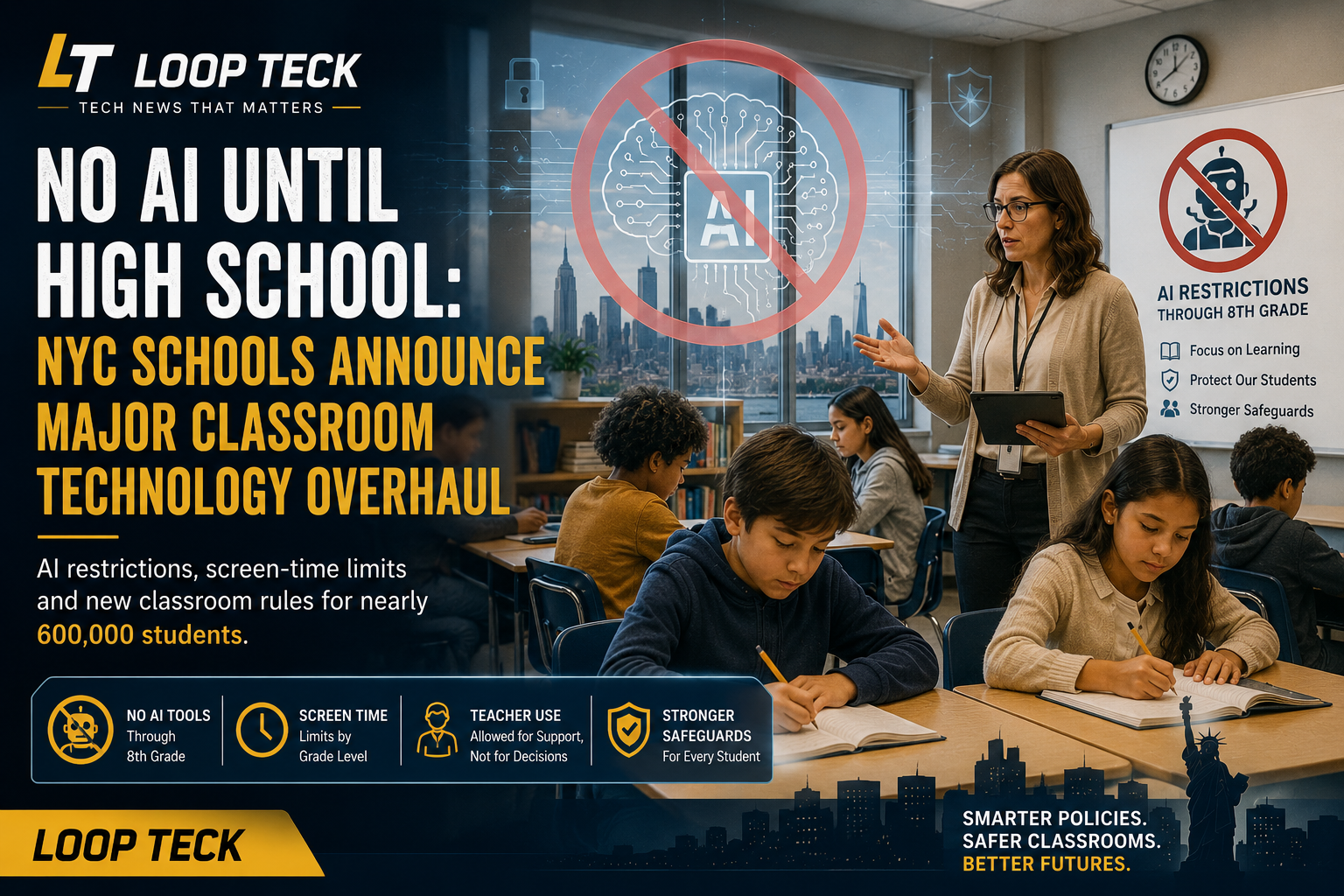
New York City is preparing to put some of the strongest limits yet on artificial intelligence and personal classroom devices in its public schools.
Under the planned NYC AI school restrictions, students through eighth grade would be prohibited from using generative AI tools such as chatbots and AI tutors in the classroom. High school students would be allowed to use AI, but only under restricted-access rules.
The technology changes go beyond AI. New limits would also reduce how much time younger students spend on individual learning devices, creating a major shift in how the nation’s largest school district approaches classroom technology.
The policy is expected to affect nearly 600,000 New York City public school students as the district prepares for the new school year.
What are NYC’s new AI restrictions for students?
The planned policy would prohibit students through eighth grade from using generative AI tools in the classroom.
That restriction would cover technologies such as AI chatbots, AI tutors and AI-powered instructional programs.
High school students would be treated differently. They would be permitted to use AI, but access would remain subject to restrictions established by the school system.
The distinction creates a clear dividing line: AI would not simply be treated as another classroom technology for younger students, while older students would receive controlled access.
For families, the practical question is straightforward: a student in elementary or middle school would not be expected to use generative AI as part of classroom learning under the new policy.
How much screen time will NYC students get?
The technology overhaul also introduces limits on individual learning devices, particularly for younger students.
How the new classroom tech rules change by grade
The restrictions get tighter for younger students. Tap a grade level to see exactly what changes.
Preschool–Grade 2
Students in preschool through second grade would not have access to personal learning devices in class.
These rules do not remove technology from NYC classrooms altogether. They place tighter limits on personal learning devices, particularly for younger students.
Why is New York City restricting AI in classrooms?
The policy comes after growing concern among parents, educators and lawmakers about how artificial intelligence and screen-based learning could affect children.
Parent advocacy organizations have called for an AI moratorium in schools. More than half of the New York City Council also signed a letter urging City Hall and the Department of Education to stop expanding AI use in classrooms.
The debate is not simply about whether AI works.
Critics of rapid AI adoption argue that some educational applications provide questionable academic benefits and can encourage students to depend on technology rather than develop independent critical-thinking skills.
Some instructional applications have also faced criticism for making schoolwork feel more like gaming while potentially making it easier for students to bypass traditional learning methods.
The underlying issue is therefore broader than software. It is a debate over how much technology should mediate a child’s education in the first place.
What can NYC teachers still use AI for?
Where can teachers use AI — and where does it stop?
The planned rules would allow approved AI tools for routine support, while keeping the technology away from decisions that directly affect students.
Teachers can use approved AI as a productivity tool for certain tasks, but the planned rules draw a line before AI is used for grading, behavior monitoring, crisis counseling or special education planning.
Why are schools making the change now?
School leaders have reportedly been waiting months for clearer guidance.
In July, principals were instructed to pause software purchases while the administration finalized its technology policy.
Earlier guidance released in March did not establish the same grade-based AI restrictions or individual-device screen-time limits now being prepared.
The timing makes the announcement particularly significant.
The nation’s largest school district is approaching the start of its new school year, with students expected to return on September 10. Schools therefore have limited time to translate the new rules into classroom practices.
How does the AI policy fit into NYC’s broader technology debate?
New York City’s approach reflects a wider argument over whether more classroom technology automatically produces better educational outcomes.
The city has already taken steps to reduce technology-related distractions through its bell-to-bell cellphone restrictions, which took effect at the beginning of the previous school year.
The new AI and device policy pushes that philosophy further.
Instead of focusing only on smartphones and distraction, the proposed rules address educational software itself.
That is a more complicated question because AI can serve very different purposes. A chatbot helping a student understand a concept is fundamentally different from an automated system grading that student’s work or contributing to a special education plan.
The policy’s separation of permitted and prohibited uses reflects that distinction.
What does the policy mean for parents and students?
For families, the biggest change is that access to AI in school will depend heavily on grade level.
A student in eighth grade or below would face a substantially different classroom technology environment from a high school student.
Younger students would also spend less time using individual learning devices. Preschool and second-grade classrooms would not provide students with personal learning devices, while students in grades 3 through 5 would be capped at 30 minutes of daily device use and middle school students at 45 minutes.
Parents should therefore expect classroom technology policies to become more structured rather than simply disappear.
The approach also puts greater emphasis on human-led instruction for younger students while reserving controlled AI access for older students.
What are teachers saying about the AI restrictions?
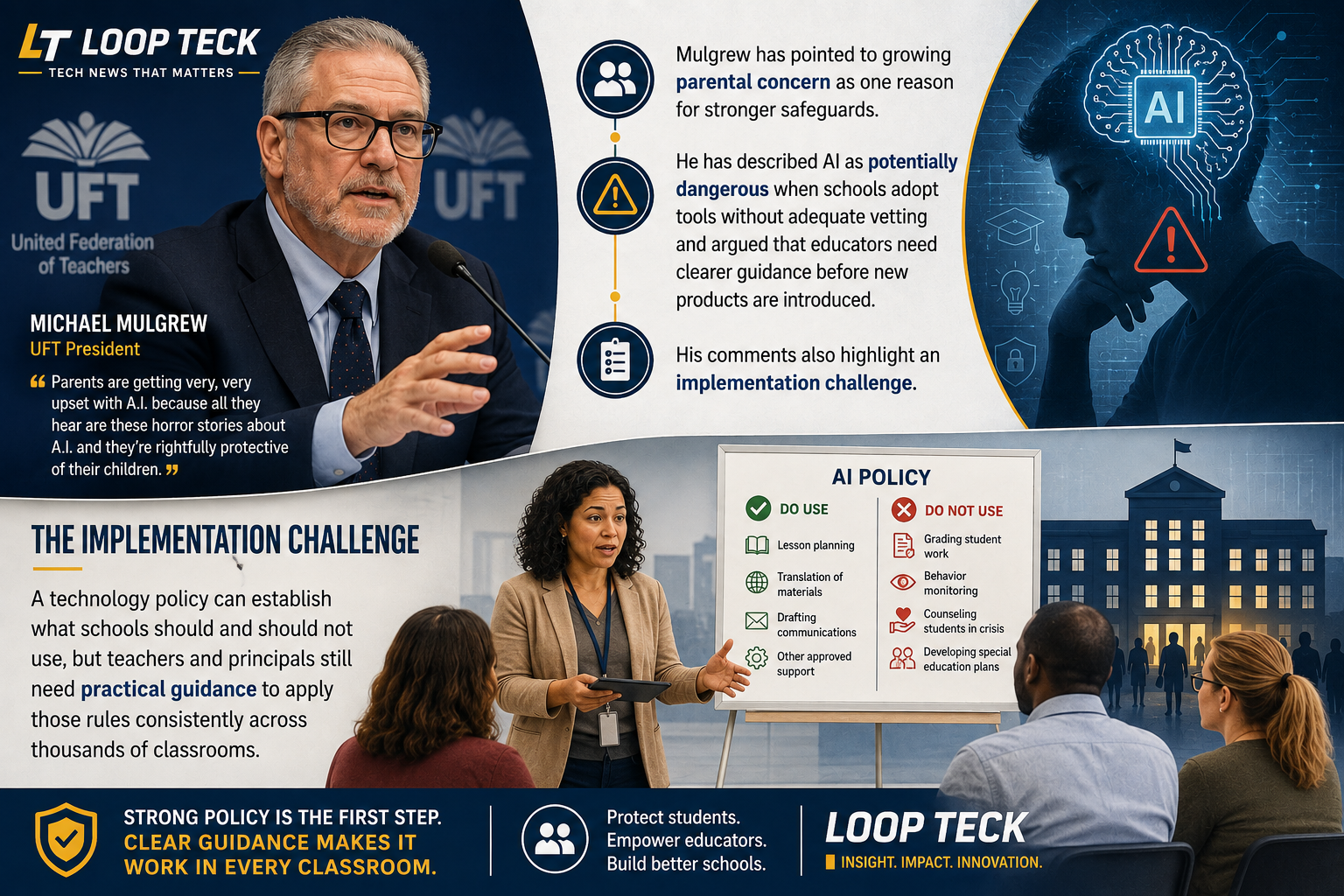
United Federation of Teachers President Michael Mulgrew has pointed to growing parental concern as one reason for stronger safeguards.
Mulgrew has described AI as potentially dangerous when schools adopt tools without adequate vetting and argued that educators need clearer guidance before new products are introduced.
His comments also highlight an implementation challenge.
A technology policy can establish what schools should and should not use, but teachers and principals still need practical guidance to apply those rules consistently across thousands of classrooms.
Could NYC’s approach influence other school districts?
The planned policy could become an important reference point in the broader U.S. debate over AI in education because New York City operates the nation’s largest public school system.
Its approach represents a relatively restrictive position: younger students would be prohibited from using generative AI in the classroom, while high school use would remain controlled.
The policy also combines AI restrictions with broader limits on individual-device use.
That makes the initiative larger than an AI ban alone. It represents a reassessment of the role of personal technology in early education.
Other districts watching the debate will have to weigh the same competing priorities: technological literacy and potential educational benefits on one side, and concerns about dependency, distraction and inappropriate automation on the other.
What happens next for NYC schools?
Mayor Zohran Mamdani and Schools Chancellor Kamar Samuels are expected to formally unveil the policy at 10:30 a.m. at the Brooklyn STEAM Center in the Brooklyn Navy Yard.
The announcement comes shortly before students return for the new school year.
The most important details for families will be how the final policy is implemented at individual schools, which AI tools qualify as approved, and how educators interpret the restrictions in daily classroom settings.
Those operational details will determine how dramatically students actually experience the technology shift.
Practical Takeaway
New York City’s planned classroom technology overhaul is not a rejection of technology across the education system. It is a decision to place much tighter boundaries around when and how children interact with it.
For students through eighth grade, generative AI would be off-limits in the classroom. High school students would receive restricted access, while younger students would also see significant reductions in individual-device use.
For teachers, approved AI remains available for tasks such as lesson preparation and translation, but not for grading, crisis counseling, behavior monitoring or special education planning.
The larger question now moves from whether schools should use AI to where schools should draw the line. New York City’s answer could become an influential case study as districts across the United States decide how much artificial intelligence belongs in a child’s classroom.
NYC AI School Restrictions: Your Questions Answered
From the eighth-grade AI restriction to classroom screen-time limits, here is what the planned New York City school technology policy means for students, parents and teachers.
What is changing in NYC schools?
Students through eighth grade would be prohibited from using generative AI in classrooms, while individual learning-device use would also be limited for younger students.
Under the planned policy, students through eighth grade would be prohibited from using generative AI tools in the classroom. High school students would be allowed to use AI under restricted access rules.
Students in grades 3 through 5 would be limited to 30 minutes of daily screen time on individual learning devices, while middle school students would be limited to 45 minutes per day. Preschool through second grade would not have personal learning devices in class.
Teachers would still be allowed to use approved AI tools for tasks such as lesson planning, translating educational materials and drafting communications.
The planned policy would prohibit AI from being used for grading student work, monitoring behavior, counseling students in crisis and developing special education plans.
Under the planned rules, the classroom restriction on generative AI would apply to students through eighth grade. High school students would have access under restricted rules established by the school system.
No. The planned limits focus specifically on individual learning devices and generative AI use. Technology would still be used in schools, but younger students would face tighter restrictions on personal device-based learning.
Under the planned device limits, preschool through second grade would have no personal learning devices in class. Grades 3 through 5 would have an individual learning-device limit of up to 30 minutes per day.
Middle school students would be limited to up to 45 minutes per day on individual learning devices.
The planned restrictions come amid growing concern among parents, educators and lawmakers about artificial intelligence and screen-based learning. Critics of rapid AI adoption have raised concerns about questionable educational benefits, dependency on technology and students’ ability to develop independent critical-thinking skills.
The planned policy could become an important reference point in the wider U.S. debate over AI in education because New York City operates the nation’s largest public school system. Other districts may watch how the restrictions balance technological literacy, educational benefits, dependency, distraction and automation.
Approved AI tools could be used for certain administrative and instructional tasks, including lesson planning, translation of educational materials and drafting communications.
Mayor Zohran Mamdani and Schools Chancellor Kamar Samuels are expected to formally unveil the policy at 10:30 a.m. at the Brooklyn STEAM Center in the Brooklyn Navy Yard.
It would create different technology rules by grade level, limit individual learning-device use for younger students, and establish boundaries around how teachers can use AI.


Loop Teck
✓Technology, AI, smartphones & the future of innovation.