


Smartphones May Never Look the Same Again
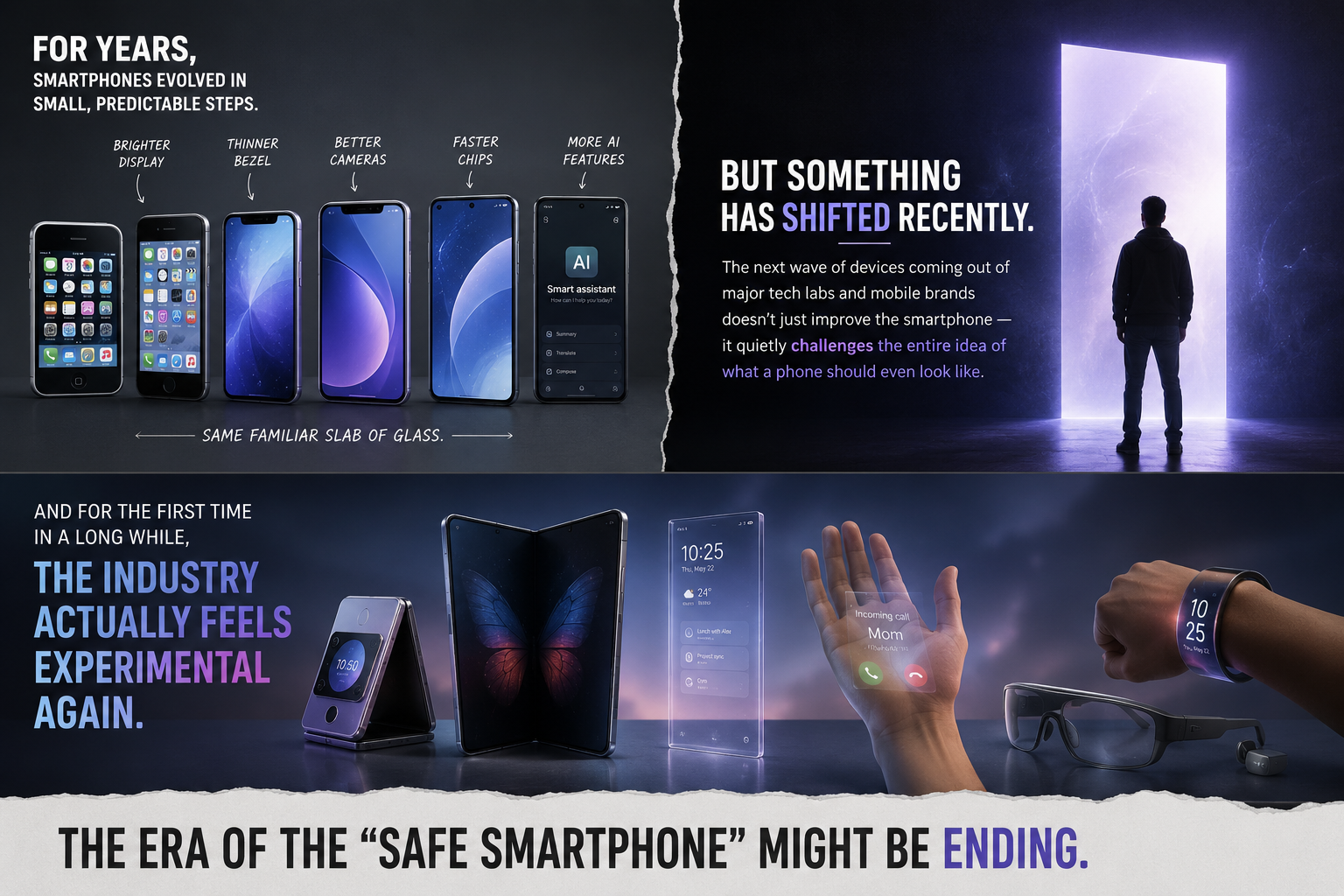
For years, smartphones have evolved in small, predictable steps. A slightly brighter display here. A thinner bezel there. Better cameras. Faster chips. More AI features squeezed into the same familiar slab of glass.
But something has shifted recently.
The next wave of devices coming out of major tech labs and mobile brands doesn’t just improve the smartphone — it quietly challenges the entire idea of what a phone should even look like. And for the first time in a long while, the industry actually feels experimental again.
The era of the “safe smartphone” might be ending.
The Glass Rectangle Era Is Starting to Crack
Modern smartphones became visually repetitive for one reason: consumers stopped demanding radical hardware changes. Battery life improved. Cameras became genuinely excellent. Displays reached absurd brightness levels. Most flagship phones were already “good enough.”
That stability pushed companies toward software ecosystems and AI services instead of dramatic physical redesigns.
Now the pressure is reversing.
Artificial intelligence, spatial computing, modular hardware, and new battery technologies are forcing manufacturers to rethink the device itself — not just what runs on it.
And some of the concepts already shown publicly are difficult to ignore.
At Mobile World Congress 2026, Chinese manufacturer TECNO unveiled modular magnetic smartphone concepts that allow users to snap external batteries, cameras, and telephoto accessories directly onto the device.
It sounds futuristic at first. Then you realize it solves a very real problem.
Phones are becoming too thin to handle increasingly demanding AI workloads, cooling requirements, and battery expectations all at once.
So instead of stuffing everything inside the phone, brands may eventually let users expand their hardware only when needed.
That’s a very different direction from the sealed, fixed designs dominating the market today.
Invisible Cameras Are Finally Becoming Real
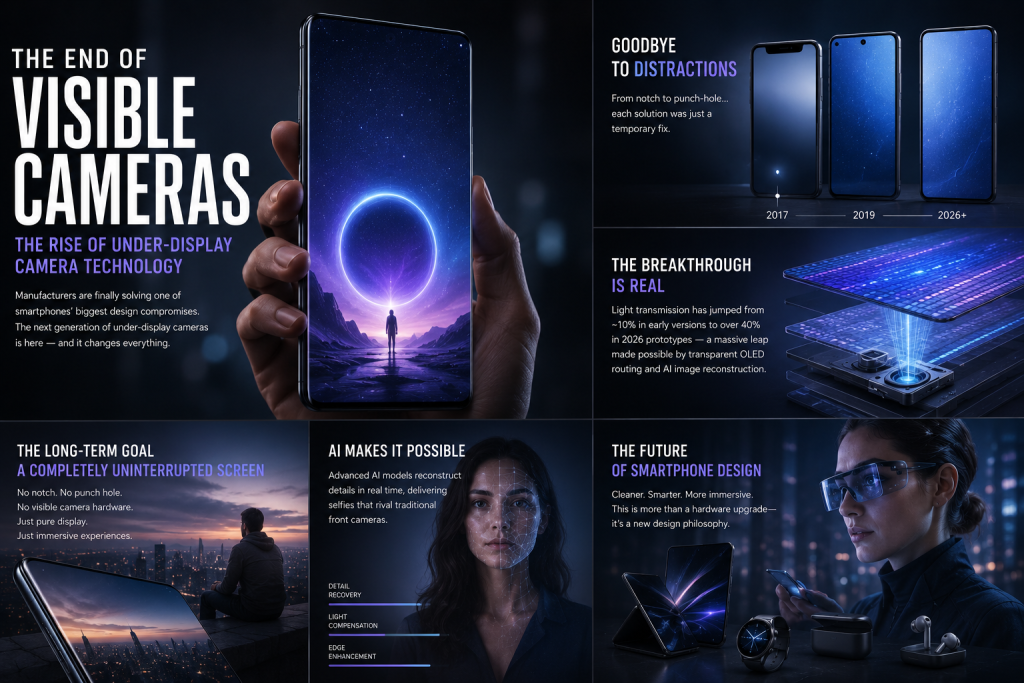
The notch era annoyed people. Punch-hole cameras were supposed to fix that. They didn’t.
Now manufacturers are trying to erase front cameras entirely.
Under-display camera technology has existed for years, but early implementations looked blurry and compromised. The display above the sensor simply blocked too much light.
That’s changing rapidly.
New 2026-generation under-display systems reportedly increased light transmission from roughly 10% in earlier versions to more than 40% in modern flagship prototypes.
Samsung, Xiaomi, and ZTE are among the companies pushing the technology forward, using transparent OLED routing and AI image reconstruction to close the quality gap between hidden cameras and traditional selfie sensors.
The long-term goal is obvious: a completely uninterrupted screen.
No punch hole. No notch. No visible camera hardware at all.
And once that happens, smartphone design instantly feels cleaner — almost sci-fi.
Foldables Are Becoming Surprisingly Practical
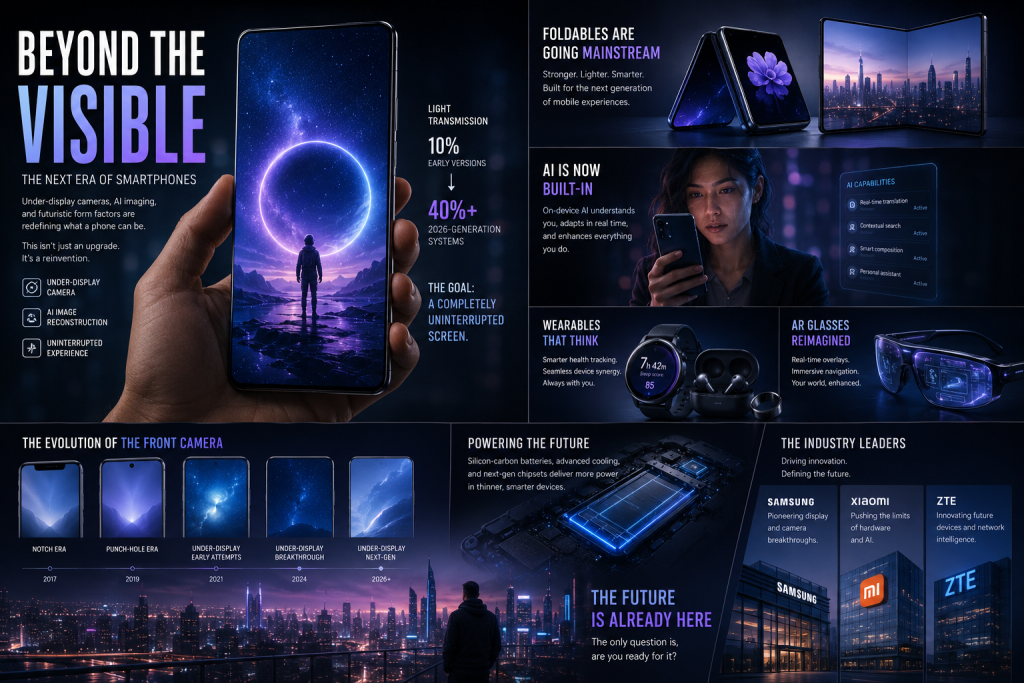
Foldable phones were initially treated like luxury experiments. Expensive. Fragile. Slightly awkward.
Not anymore.
The newest foldables are thinner, brighter, more durable, and far more refined than early generations. Some models are now approaching regular flagship dimensions while offering tablet-sized displays when unfolded.
Honor’s latest foldable concept, for example, combines an ultra-thin design with a massive silicon-carbon battery and flagship durability ratings.
Meanwhile, Motorola’s latest Razr lineup has demonstrated how newer battery technologies are making foldables dramatically more practical in daily use.
That matters because foldables no longer feel like a niche category trying to prove itself.
They’re starting to feel inevitable.
The moment foldable devices become affordable enough for mainstream buyers, the traditional flat smartphone could suddenly look outdated very quickly.
The Battery Revolution Is Quietly Reshaping Phones
One of the biggest smartphone breakthroughs isn’t visual at all.
It’s chemical.
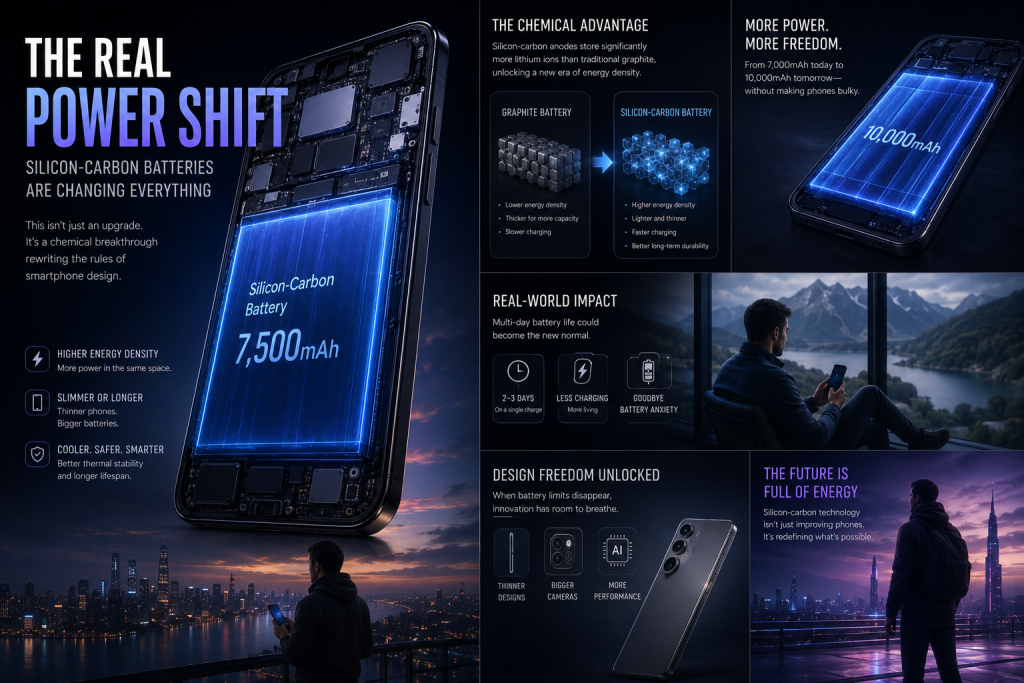
Silicon-carbon battery technology is rapidly emerging as one of the most important shifts in mobile hardware because it increases energy density without dramatically increasing size.
In practical terms, that means slimmer phones with larger batteries.
Or thicker phones with absurd endurance.
Some recent devices are already pushing beyond 7,000mAh capacities while remaining relatively thin. Industry analysts expect 8,000mAh to 10,000mAh batteries to become increasingly common over the next few years.
That changes design priorities completely.
Manufacturers no longer need to sacrifice battery life for thinness. Users may finally stop carrying power banks everywhere. Multi-day battery life could become normal instead of premium.
And once battery anxiety disappears, companies gain freedom to redesign the phone around entirely different experiences.
AI Is Changing the Hardware Itself
For a while, AI features felt mostly cosmetic.
Smart wallpaper generation. Text summaries. Editing tricks.
Useful? Sure. Revolutionary? Not really.
But the next phase of mobile AI appears far more integrated.
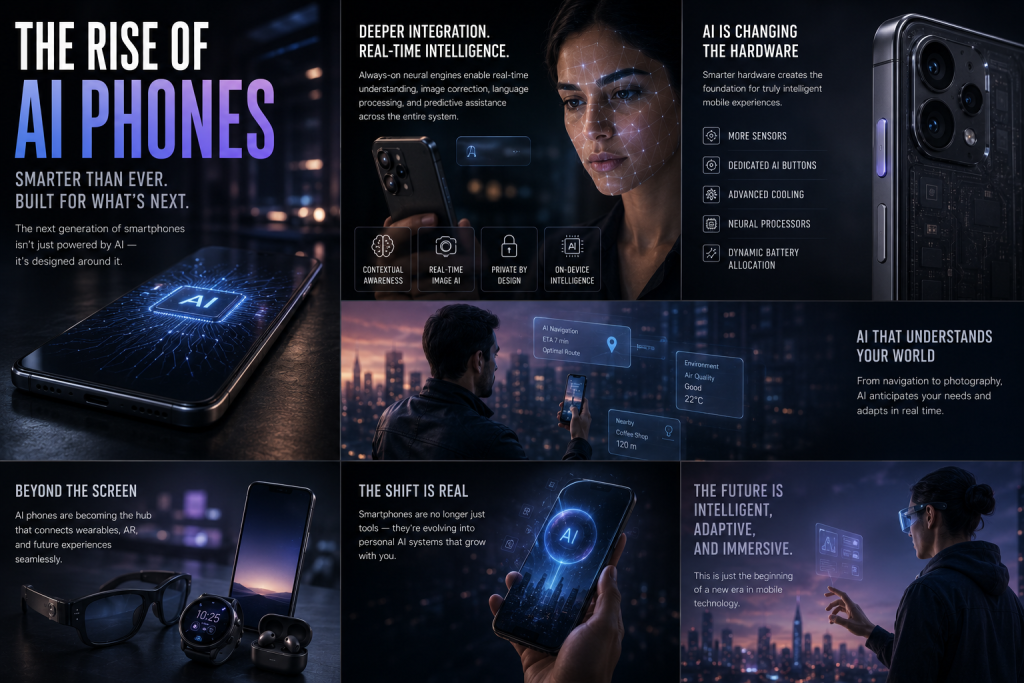
Future smartphones are increasingly being designed around always-on neural processing, contextual awareness, real-time image correction, and device-level intelligence.
That shift has consequences for hardware.
More sensors. Smarter cameras. Better cooling. Dedicated AI buttons. Advanced privacy displays. Dynamic battery allocation.
Phones are no longer being designed simply as communication tools.
They’re evolving into portable AI systems.
And eventually, that may blur the line between smartphone, wearable, assistant, and augmented reality device altogether.
The Transparent Phone Fantasy Isn’t Completely Dead
Every few months, viral videos claim transparent smartphones are coming soon. Most are fake. Some are outright CGI.
Still, the underlying idea isn’t entirely impossible.
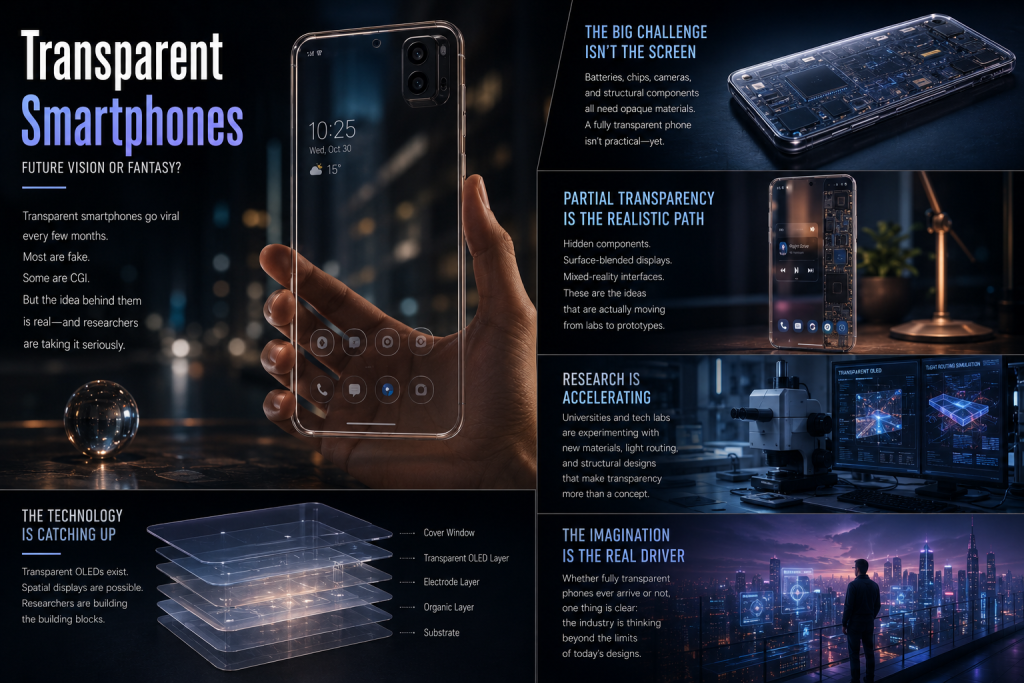
Transparent OLED displays already exist in various forms, and researchers continue experimenting with spatial and blended-display concepts.
The bigger problem isn’t the screen.
It’s everything else.
Batteries, processors, cameras, and structural components still require opaque materials. That makes a fully transparent smartphone impractical for now.
But partial transparency? Hidden hardware? Surface-blended displays?
Those ideas are slowly entering legitimate research territory.
Which says a lot about where the industry’s imagination is heading.
Smartphones Are Approaching Another Major Identity Shift
The strange thing about smartphone innovation is that it often feels invisible until suddenly everybody notices it at once.
- Touchscreens felt experimental once.
- Multiple cameras felt unnecessary once.
- Foldables looked ridiculous once.
Now the industry is entering another transition phase — one driven by AI, battery chemistry, modularity, and display technology all colliding simultaneously.
The result may not be a single revolutionary device.
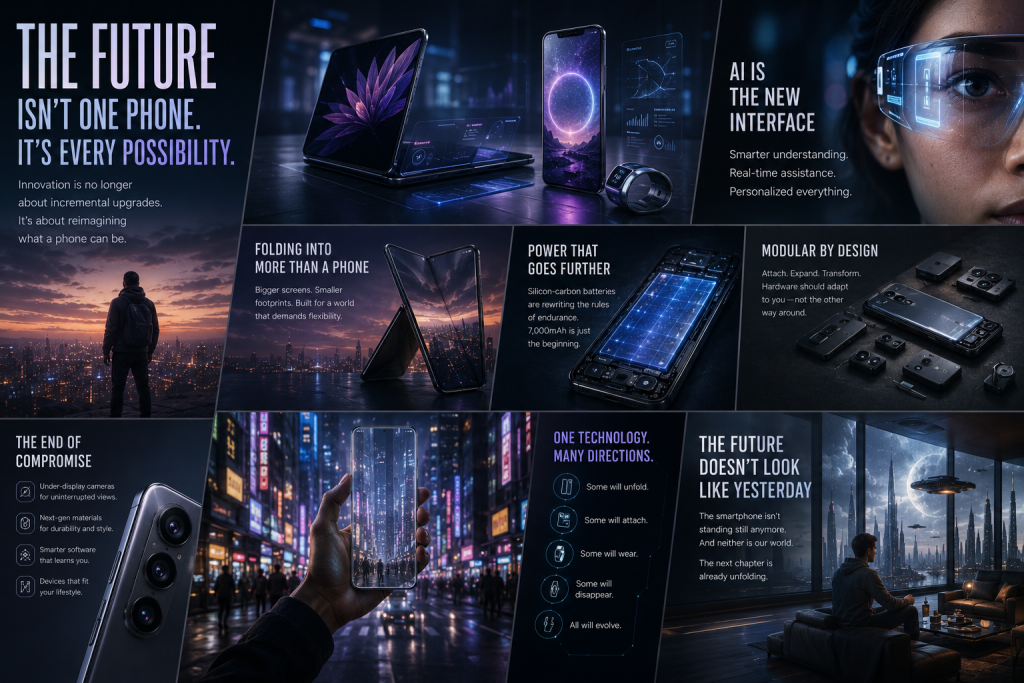
Instead, we’re likely heading toward a fragmented future where phones adapt to different lifestyles more aggressively than ever before.
- Some will unfold into tablets.
- Some will attach external hardware.
- Some may disappear into wearables or AR systems.
- Others might become nearly bezel-free sheets of intelligent glass.
- Either way, the smartphone industry no longer feels stuck.
And after years of incremental upgrades, that alone makes the future far more interesting.
Smartphones May Never Look the Same Again
Discover the biggest smartphone innovations shaping the future — from AI-powered devices and foldable displays to invisible cameras, futuristic batteries, transparent concepts, and next-generation mobile technology.
Yes. Smartphone manufacturers are rapidly moving beyond traditional glass slab designs. Future smartphones are expected to feature foldable displays, AI-powered interfaces, invisible under-display cameras, modular accessories, thinner bezels, and advanced battery technologies that dramatically change how phones look and function.
The biggest smartphone trends include foldable phones, AI-focused hardware, silicon-carbon batteries, under-display selfie cameras, thinner flagship designs, modular smartphone concepts, and on-device AI assistants. Brands are increasingly focusing on intelligent experiences rather than only raw hardware upgrades.
An under-display camera smartphone hides the front camera beneath the display itself, removing visible punch holes and notches. Advanced OLED technology and AI image processing allow the screen to stay uninterrupted while still maintaining selfie and video call quality.
Foldable smartphones are becoming more popular because they now offer better durability, improved software optimization, stronger hinges, brighter displays, and significantly better battery life compared to earlier generations. Many consumers also prefer the larger screen experience without carrying a tablet.
Silicon-carbon batteries are next-generation batteries designed to hold more energy than traditional lithium-ion batteries. They help smartphones become thinner while still delivering significantly longer battery life, faster charging, and improved efficiency.
AI is transforming smartphones through real-time translation, advanced camera processing, contextual assistants, adaptive battery optimization, intelligent search, on-device content generation, and personalized user experiences. Future smartphones are increasingly being designed around AI-first functionality.
Fully transparent smartphones are still technically difficult because internal components like batteries, processors, and camera sensors remain opaque. However, transparent OLED displays, hidden components, and futuristic blended-display concepts are actively being researched by major technology companies.
AI may reduce the need for traditional apps over time by enabling conversational interfaces that perform tasks directly through intelligent assistants. Many industry experts believe future smartphones will rely more heavily on contextual AI systems rather than manually opening separate applications.