

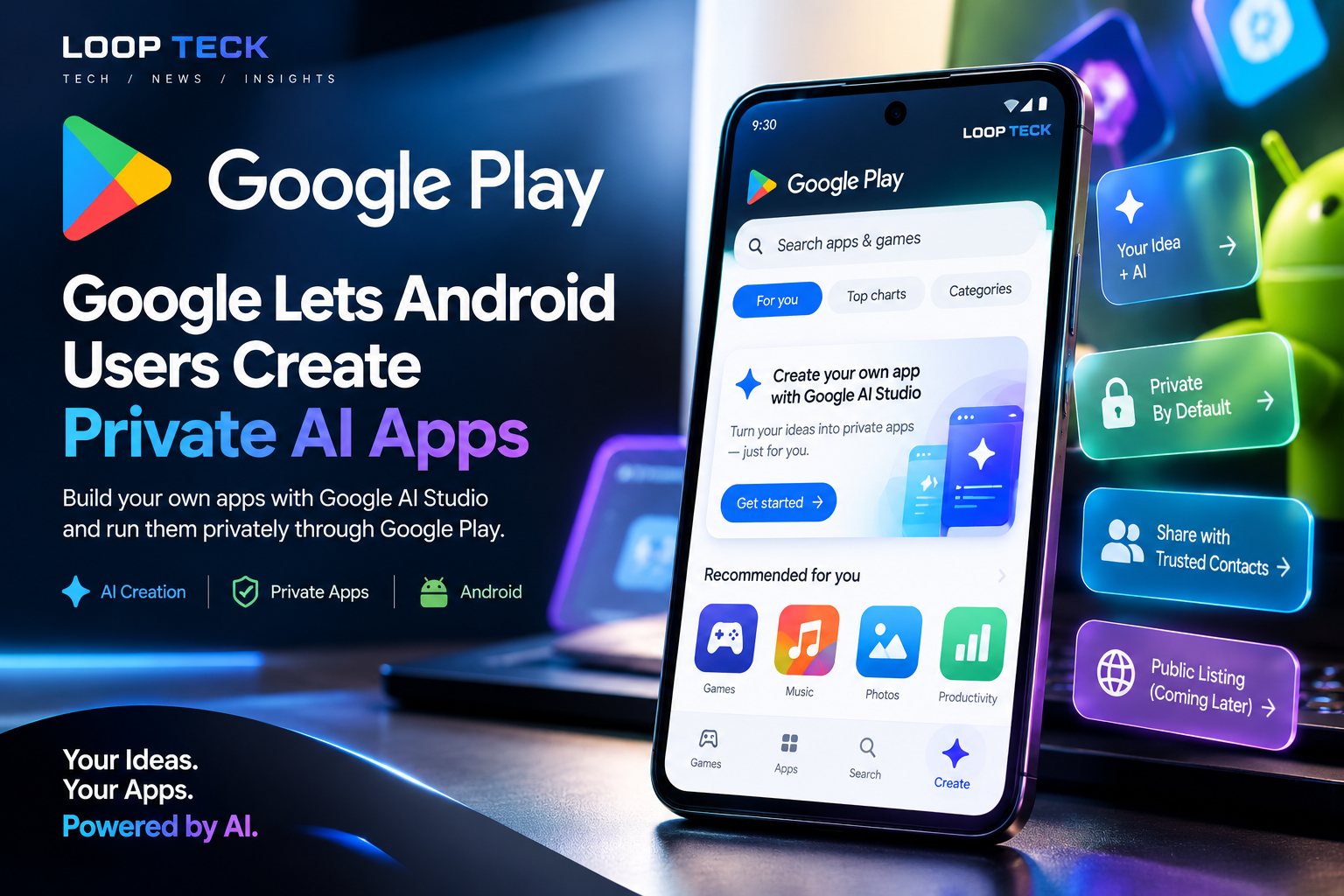
Android users may soon be able to create their own apps without making them public. Google has announced a feature that will let users in the United States build personal apps with Google AI Studio and run them privately on their devices through Google Play.
The idea goes beyond adding another AI tool to Android. Instead of searching for an app that almost meets a particular need, users could create one tailored to their routines, interests or personal projects. Google has cited examples such as habit trackers, local sports league organizers and personal finance tools.
The initial model is private use. These apps will not appear in Play Store search results or public listing pages, according to the supplied report. Google also plans to introduce options for sharing creations with trusted contacts and, later, publishing them publicly after safety and trust reviews.
Google Play Is Moving Toward Personal AI-Generated Apps
Google’s latest Android announcement points toward a different way of thinking about mobile software: an app does not always need to be designed for a mass audience.
Traditional app stores connect developers who build products with users who download them. Google’s proposed feature introduces another possibility. An individual could use AI to create a tool for a specific task, then access it privately through the company’s existing app ecosystem.
That could make small, highly personal applications more practical to create. It also raises questions about how these apps will be managed, secured and shared.
How will Google’s private AI apps work?
Google AI Studio will provide the app creation experience, while Google Play will be the route through which users run their creations on Android devices.
The announcement describes a process that uses an existing Google account. Users would create an app for their own needs and install or access it through Google Play without releasing it as a public product.
The distinction matters because a private app does not need to appeal to thousands of potential users. Its value comes from solving one person’s problem.
For example, a user might want a simple habit tracker with a particular set of daily activities. Another might need a tool to organize a neighborhood sports league. Someone else could prefer a personal finance interface designed around their own budgeting categories.
These are examples of potential uses, not confirmation that Google has announced dedicated templates for each task.
The broader concept is often associated with vibe coding: describing what software should do in natural language and using AI to help generate it. Rather than manually building every component, the user starts with an idea and works toward a functioning application.
However, the supplied announcement does not specify which programming languages, development controls or advanced customization options the feature will support.
Why private distribution matters more than it first appears
The most distinctive part of Google’s announcement is not simply that AI can help generate an app. It is the proposed ability to run that app privately without publishing it to the public Play Store.
According to the supplied report, these personal apps will not appear in public Play Store search results or listing pages. They will also remain inaccessible to other users, apart from the creator.
That separates personal software from conventional app publishing. A user would not need to present a polished product to a broad audience just to create a useful tool for everyday life.
It could also change what users expect from an app store. Instead of treating the store exclusively as a catalog of products created by developers, Google is exploring a model in which users can create software for themselves.
There are still important details to establish. The announcement does not explain the full privacy architecture, how permissions will work, what data personal apps can access or how updates will be delivered. Those questions matter before users rely on generated apps for sensitive information.
What changes when AI-generated apps can be shared?
From Personal AI App to Public Release
Google’s planned approach creates three possible stages for AI-generated apps. Select each stage to explore who can access an app, what changes, and where safety reviews enter the picture.
Interactive concept · Not an official Google UIAn app built for one person
A creator builds a personal app for a specific need and uses it privately. It is not listed in public Play Store search results.
My Daily Planner
A personal productivity app created for your own routine.
A private listing status does not, by itself, prove how an app handles data or permissions.
Google is also changing how people discover games
What if your app store became your AI assistant?
From personalized game discovery to AI-powered app comparisons, Google’s expanding Play Store experience points toward a more interactive way to find and choose mobile software.
Four changes to watch
Select a feature to explore what it could mean for users.
Find games that fit your style.
A Gemini-powered discovery experience could make it easier to find games based on the genres and experiences you enjoy, rather than relying only on browsing categories.
Build your game profile
Choose the experiences you like to see a sample recommendation. This is a local demo, not Google’s actual Game Finder.
Gaming becomes more social
Community Posts and time-limited Sprints point toward more ways to engage with games inside the store.
Community Posts
Game-related community content creates another potential touchpoint for players exploring titles and discussing their interests.
COMMUNITY EXPERIENCE48-hour Sprints
Short-duration challenges introduce a time-limited activity format that could give players a reason to return.
TIME-LIMITED CHALLENGESAn app store can be more than a download directory: discovery, community activity and challenges can connect different stages of the gaming experience.
Compare before you install
Choose a sample app category and tell this demo what matters to you. It will generate a comparison checklist locally, without sending data to an AI service.
This is an illustrative checklist, not a live Ask Play result or a verified ranking of apps.
What if you could create the app you need?
Personal AI app creation points beyond choosing existing software. In principle, AI could help turn a specific need into a customized digital tool.
Concept exploration only. This interaction does not create, install or deploy a working app.
From finding apps to making apps
The most important shift may be the changing relationship between users and software.
Will AI simply help people choose better apps, or will it eventually help them build more of the software they need themselves? That is the bigger possibility behind personal AI app creation.
What Android users should know before relying on personal AI apps
The feature could make it easier to experiment with small, purpose-built tools. Nevertheless, generating an app does not automatically make its output accurate, secure or suitable for sensitive tasks.
A personal finance app, for example, might appear to work while still producing incorrect calculations or handling data in ways its creator does not expect. A habit tracker could be relatively simple, but it would still need to behave consistently to be useful.
Users should therefore consider what information an app handles, which permissions it requests and whether its results can be checked independently. These are general precautions for AI-generated software, not a list of specific Google restrictions confirmed by the announcement.
The practical value will also depend on details that remain unspecified, including availability, supported devices, creation limits and the level of technical knowledge required.
For now, the source identifies the United States as the target market for the announced feature. It does not provide a confirmed rollout date or establish availability in other countries.
Practical Takeaway
Google’s announcement introduces a potential new route to personal Android software: create an app with AI, use it privately through Google Play, and eventually gain options to share it or publish it publicly.
For users, the immediate attraction is customization. A small tool no longer has to become a commercial product to be worth creating.
The key milestones to watch are the feature’s actual U.S. rollout, its device and account requirements, the privacy and security controls for generated apps, and the details of Google’s planned sharing and publishing process. Until those are clarified, the feature’s full practical scope remains uncertain.
Google’s Private AI Apps: Your Questions Answered
Google wants Android users to build apps for their own needs. Explore how private AI-generated apps could work, what Google plans next, and what remains unknown.
They are personal applications users can create with Google AI Studio and run privately on Android through Google Play, according to the announcement.
Instead of relying only on existing apps, users could create tools tailored to specific needs, such as habit tracking, organizing a local sports league or managing personal finances.
Not under the initial private-use model. The supplied report says these apps will not appear in public Play Store search results or listing pages.
Google plans to introduce public publishing after safety and trust reviews. That future option is separate from creating an app for personal use.
The announcement identifies Android users in the United States as the intended audience. Users are expected to work through their existing Google accounts.
The supplied report does not confirm a worldwide rollout, a specific launch date, device compatibility requirements or detailed account eligibility rules.Google plans to let users share their creations with a trusted circle of friends in the months ahead.
This is a planned extension, not a confirmed feature available to everyone today. The source does not specify sharing controls, recipient limits or a release date.
Vibe coding generally means describing the software you want in natural language and using AI to help generate the application.
In Google’s announced approach, the idea is to make personal software creation more accessible. However, the source does not detail the coding tools, supported languages or customization controls users will receive.
Not necessarily. Keeping an app out of public search results does not, by itself, establish how its data is stored, what permissions it uses or how securely it operates.
Users should check requested permissions, verify important calculations and be cautious with sensitive financial or personal information.
Google’s complete privacy architecture and security requirements for these personal apps are not specified in the supplied announcement.The announcement also covers four updates:
Game Finder: Personalized game recommendations powered by Gemini.
Community Posts: New community-oriented content within Google Play.
Sprints: Gaming challenges that run for 48 hours.
Ask Play: An updated AI assistant designed to compare similar apps directly.
The supplied report does not give a confirmed worldwide release date. It identifies users in the United States as the audience for the announced feature.
Google also describes app sharing and public publishing as future additions. Android users in other regions should wait for official availability information rather than assume the feature is already accessible.
GTA VI: The Bigger Picture
A closer look at the gaming industry’s biggest upcoming release, the expectations surrounding it, and what GTA VI could mean for the future of gaming.
Watch the Full Breakdown
Hit play and explore the story behind GTA VI, the expectations surrounding Rockstar’s next major release, and why the game has become such an important moment for the wider gaming industry.
The scale of anticipation surrounding the title makes it an interesting case study in modern gaming — from blockbuster franchises and consumer attention to hardware demand, entertainment culture, and the changing relationship between players and major game publishers.
The important question is not simply how successful GTA VI will be. It is how much influence one major release can have across the wider gaming ecosystem.